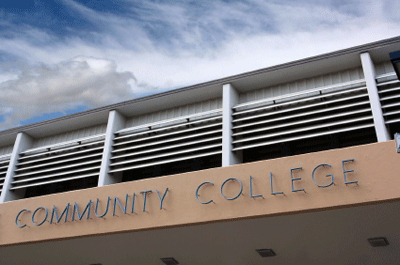
Photo courtesy of www.ed.gov
By DIANE WAI
Editor’s note: With shrinking funds for higher education due to budget cuts, students are facing an increasingly hostile environment on campus. One student in
Victoria Conlu, 22, grew up in a multi-generational Filipino household with her mom, siblings, aunts, uncles and grandparents in the
Several years ago,
A top student at
The first week of class brought many unexpected challenges.
“There were people desperate to get classes,”
“It took me a whole year to realize that I needed to nudge my way into places,”
One semester, it was essential for
“I had to plop myself down into a seat and stay. I was not going to leave,” she says. “I’d just sit in the classroom, and I was like ‘I’m not leaving.’”
Her persistence paid off and the professor added her to the class.
“I think the way the registration system works at CCSF is that there are a certain number of students who can enroll. Then, the online registration gets shut down, and no other people can enroll. The teachers can give out these special permit codes to a certain number of people,” she says. The special permit codes allow teachers, at their discretion, to add students beyond the online enrollment limit.
Many times, courses are offered at inconvenient times, or they overlapped with one another. “Let’s say I needed to take an English class, a math class and a science class. They would all overlap each other. You’d have to pick one, and then you’d have to wait until the next semester to take the next class. By then, there would be a backlog of people who also needed to take that same class.”
Like many students,
At the time, she lived in Brentwood, an East Bay city about 60 miles from
“I’d have to leave about 5 a.m. to get to a 9 o’clock class,” she says. “I was always bringing my homework on the train and doing it to and from school, and eating breakfast at school while walking between classes.”
“Many times people won’t tell you what resources are available and you have to snoop around for yourself just to see what’s there and what’s useful to you,”
“That’s what trips people up. They’ll take a class, and then realize they took the wrong class. They won’t know exactly what’s required. It helps to talk to people who can help you stay on track.” Class planning can be done by counselors or by peer-to-peer mentors.
When
Another issue
“I think the circumstances are such that everybody has to compete with each other and that makes people more prone to make divisions,” she says. “The competition builds hostility between ethnic groups, well-to-do students, and those who need more aid, and that makes for a hostile learning environment.”
____________________________________________________________________________________________________________________________
A sense of “despair” hangs over community college campus
By DAVID MAGALLANES
As I walk across campus at the community college where I teach, I sometimes get the impression that I can almost hear my own footsteps as I walk toward my classroom or to an office I need to visit. In the parking lots, students actually have plenty of parking to choose from (there’s always an upside…). I almost feel as if, compared to the boom times of yesteryear, I’m in a ghost town. Well, I don’t exactly see tumbleweeds blowing across the fields, but we just don’t have the number of students we used to have. And not because they don’t want to attend. It’s just that we don’t have the classes for them due to budget cuts.
I tried looking up some recent statistics on the college website, but the last ones posted were for Spring 2011. I noted that our student population was at a peak in 2008, and then — right about the time the recession hit — we started our decline in student population.
The budget cuts have not yet fully impacted us. We’re scheduled to see more devastation in the coming months. Not just classes, but sports, cafeterias and student services are being slashed and burned throughout the county’s colleges because the state is no longer funding them, or because the college district considers them a lower priority than other aspects of education. At our college, we recently found that we’re losing a chunk of our arts and other programs next semester. I’ve sensed the system collapsing around me for the past couple of years, and every time I think it can’t get worse, it does.
I see my students “freeway-flying” around the county — and surrounding counties — to different colleges both within and outside the district, trying to get the classes they need to graduate. I see students without cars who can’t possibly commute between cities to do this, even if they want to, because we live in Southern California, where taking a bus is so time-inefficient that it’s not even worth it in many cases for those who have tight schedules — like students.
I also see students crushed by the daunting prospect of funding a university education, assuming they can even get the classes they need. I have engineering students in my classes who couldn’t even get into the comparable classes on their university campus because they were blocked from doing so by the sheer numbers of students already taking those few precious seats. I hear of education graduates who are ready to teach in our classrooms, but can’t find job positions open and available at our K-12 schools. I read about companies hiring engineers from other countries, especially China and India, because we don’t grow enough of our own expertise. We can’t expect to train engineers and scientists if we don’t have the classes and the support for them. Our K-12 schools are creaking under the burden of all the testing they are obligated to do, and of all the students with so many needs; as a result, inspiring students with the arts or the beauty of mathematics or the wonders of science, or teaching them to handle their own finances, or how to repair an automobile, although to some extent accomplished, is necessarily secondary.
I hear of graduates with master’s degrees working far below their level of preparation because they can’t find the employment to which they had aspired. I sense a hint of despair in the general college student population because they don’t know if all their efforts are going to pay off. On the contrary, they wonder if they will be saddled with a student debt that they can’t possibly repay. Taking on student debt becomes a gamble of a lifetime.
My daughter got through the system just before it started imploding. But as the doors close behind her, I start to worry about my grandsons’ futures. If things are going down in flames so quickly, right before our eyes, what can they hope for?
We will have to teach our young people not to depend so heavily on the same institutions that we boomers grew up in. During our halcyon days, those institutions carried out their missions. But now their hands are tied, and we seem to be facing the prospect of a lost generation.
There’s always a solution to changing economic times. The key is adaptation. Young adults will have to learn to be more self-sufficient, more creative as they design their careers, and more flexible as the direction of the wind changes quickly. To a large extent, they will have to learn to educate themselves. They will have to take more chances, and remain nimble and ready. They will have to disabuse themselves of many notions regarding careers that they were taught by their parents and boomer teachers. They will have to learn to use technology in ways that were inconceivable to their parents when they were young, and that enhance their work and make them more marketable.
I sense a deepening divide between the educated and the less-educated. The educated, if they learn to adapt efficiently, will thrive. Those who are less educated, if they are more creative, will likewise thrive. I’m concerned about those who are not highly educated, nor highly creative, and not part of a rich family.
Despite this rare display of pessimism on my part, I am cautiously hopeful.
In an article from the Ventura County Star published March 25, “Despite woes, U.S. still perceived as No. 1,” Canadian foreign policy professor Michael Hart, observes that “If you’re going to be sick and you can afford it, the U.S. is the place to be — for speed, for thoroughness.”
He’s right: IF you can afford it.
But in terms of education, Hart suggests that as solid as Canada’s education system may be, his country lacks any universities on par with America’s best, though unspoken here is the implication that our higher education offerings are still world-class … IF you can afford it.
In the same article, I read that Alexander Fortes, a Brazilian labor historian currently at Duke University as a visiting professor, states, “If the U.S. doesn’t get back its capacity to fulfill the American dream on a more inclusive basis, it won’t get back to playing a leading role, in a more positive way, globally.”
He continues: “I think the U.S. will be the dominant power for a long time. But which kind of future is it going to offer its own citizens in terms of social inclusiveness, good education, good health care?”
The 2012 elections are just around the corner. In many respects, we will be deciding the answer to that question in November.
David Magallanes is a writer and an emeritus professor of mathematics at Oxnard College, where he taught mathematics for 30 years. He can be reached at [email protected]. This was distributed by Amigos 805 and New America Media.