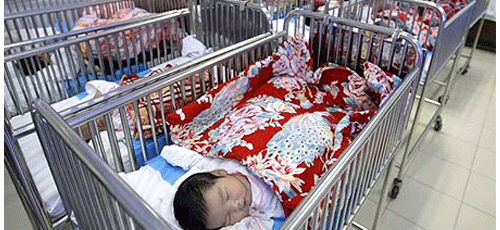
Photo courtesy of www.guardian.co.uk
From WIRE REPORTS
Nguyen Do Thi Thu Giang never was very lucky. But her older brother, Nguyen Khac Lam, remembers her as kind.
Lam and Giang lived in their mother’s house in Sai Gon’s District 1 with about a dozen relatives; they earned a meager wage working at a family photo printing business. Sometimes, Giang went to the local market and gave housewives backrubs to earn extra money.
In 1999, when a friend brought her an unwanted daughter, Giang broke custom and adopted the little girl. Three years later, she had a son of her own.
The father left, Lam says, and only returned to ask for money.
Four years ago, it seemed Giang’s luck had changed.
Tran Kim Quy, a former neighbor who had married an American and resettled in
“[Giang], a poor woman living in the heart of Sai Gon had to have a heart if she was willing to adopt a kid,” Quy told Vietweek by telephone. “I said I’d find her an American husband so she could migrate to work in the
When the old woman returned to her home in
“He seemed gentle and educated,” Quy said. “I asked him if he wanted to marry a Vietnamese woman,” she said. “I told him about Giang – a lovely mother of two. I gave [Smith] her email address and they contacted each other.”
Welcome home
After a lengthy email correspondence, Smith first visited Giang in 2008, Lam says.
The older suitor continued to visit her family for two-month stretches and stayed at their crowded home, according to Lam. Even though Smith was 31 years Giang’s senior, Lam says his family welcomed the American with open arms.
“We took care of him like a baby,” Lam recalls. “He seemed like a nice man.”
After a year of these visits, Smith married Giang in Sai Gon. In his wedding photo, he stands grinning in a dark suit, next to Thu Giang who glows in red silk and white makeup.
Smith continued to go back and forth from
“We knew he was retired,” Lam said. “But he said he had to ‘take care of some business.’”
On Nov. 20, 2009, Smith accompanied Lam and the family to the Tu Du hospital.
“Smith was so happy,” Lam recalls. “He said ‘I’m going to shout for joy; this is the first son I’ve ever had.’”
Nguyen Anh Tuan (whom the family calls “Dylan”) came out looking just like his father, according to Quy, the matchmaker.
“Smith and Dylan look like two drops of water,” she said.
An orphan is born
Thu Giang died the day after giving birth to Dylan; her death certificate cites an allergic reaction to antibiotics as the cause.
At her funeral, Smith donned a traditional white robe and lit incense for his late wife.
Days later, Lam says his brother-in-law left for
“We didn’t think it was strange,” he said. “We thought he’d come back like he always did.”
Dylan slept on the floor with his two orphaned half-siblings. He was doted on by his relatives and watched over by his grandmother, who is just two years older than Smith.
Over the next three months, Lam says Smith continued to send small amounts of money (about $400, in total) and chat with Lam on Yahoo! Messenger. Lam would cut and paste his brother-in-law’s words into Google translate.
One day, he found himself awkwardly asking why Smith had stopped sending money.
The reply was devastating.
“That’s not my son, that’s not my son,” the text read.
In January 2011, Lam shelled out $250 to analyze Dylan’s DNA. He sent the results to Smith, who refused to take a test himself.
“It was very frustrating,” Lam said.
In pursuit of a passport
The 45 year-old picture framer, with a wife and children of his own, recalls feeling disgusted by Smith’s rejection.
“We don’t want his money,” he says. “All we want is for Dylan to have American citizenship.”
Lam says Dylan is a “slow” child, still unable to walk or talk. Doctors at the Sai Gon Children’s Hospital 2 told Lam that the child’s development had been impeded by the medication that caused his mother’s death.
Believing, perhaps naively, that Dylan would have a better chance of getting care for his disabilities as a
Lam says he sought help from the U.S. Consulate (which gave him a list of lawyers in
Representatives from Nelson’s office confirmed that they had reached out to Smith, who denied he was Dylan’s father.
“Once [Smith] denied paternity and refused to submit to a DNA test, it became a legal issue so we sent [Lam] the list of lawyers,” said a representative from Sen. Nelson’s office, speaking on condition of anonymity.
The elusive Mr. Smith
Repeated attempts to contact Smith for this story failed.
An old email address provided by Quy (his neighbor) yielded no response.
Quy said her own efforts to confront Smith have been thwarted by Smith’s American girlfriend. “She’s as aggressive as a devil,” she said.
Efforts to track Smith to properties in
Quy provided the address of a trailer unit in Port Saint Lucie.
But, a cell phone number provided by the management office of a trailer park in Port Saint Lucie elicited a furious response from a Southern woman who declined to give her name or answer questions.
“Delete this number from your phone,” she shouted. “Don’t call here or I’ll contact the police.”
Quy suspects that Smith may be sick or dying.
The Amerasian trap
The difficulties Lam has faced underlie a total lack of options for American children abandoned abroad.
The overwhelming majority of these cases appear to be children born out of wedlock to
Historically, they have been known as Amerasians.
During the 1980s and ’90s, Vietnamese, Thai, Korean and Japanese individuals who exhibited identifiable Caucasian or African American physiology were granted permanent resident status in the
Approximately 87,000 Amerasians (and people claiming to be their relatives) emigrated from
Now, Vietnamese children abandoned by American fathers have few options.
“There is no law or process that compels a U.S .citizen to establish a citizenship claim for a child born abroad,” wrote one U.S. State Department official. The official added that she knew of no organization that provides legal assistance to children abandoned by American fathers.
Making a case for Dylan
As of press time, the U.S. State Department had not provided specific response to questions about Dylan’s case.
They maintain, however, that a child born under his circumstances does not need an American father’s help to obtain a passport. They need only submit proof of the father’s citizenship, documentation of the marriage and proof of the father’s residence in the
“Unfortunately, in practice, what the State Department says just doesn’t apply,” said Cal Nguyen, a Vietnamese American attorney who has provided Lam with free legal advice.
Nguyen points out that the State Department requires a sworn statement signed by Smith and information that only he could provide. For a poor Vietnamese citizen like Lam, that information is practically impossible to produce without help from Smith.
“Unless the Consulate waives its requirements for an affidavit, I don’t see any way of getting this done without the father’s cooperation.”
Three legal aid attorneys based in
“With most [paternity cases] you have to reside in the state for six months to file suit,” said Tin Thanh Nguyen, an attorney based in
However, Linda Osberg believes the case is open and shut. The high-powered
Because Smith and Giang were married when they had Dylan, the law presumes that Dylan is his son. As of press time, Osberg had dispatched an investigator to track down Smith.
“Let’s get this kid a passport and some money,” she said.