From The Guardian
Moving bits of paper around (the old way) or painting with billions of pixels (the new) has conjured up some of the greatest films of all time. From The Iron Giant to Persepolis, Guardian and Observer critics pick the 10 best.
The Tale of the Fox
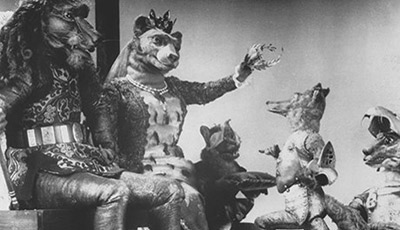
10. The Tale of the Fox
A sneaky fox plays a series of underhand tricks on his neighbours in the animal kingdom, among them a timorous hare and a gullible wolf. The king of the beasts, a lion, summons him to face charges but the fox proceeds to outwit everyone, including the king himself. When Ladislas Starevich told this tale in the 1930s it was by no means new – versions of the Reynard story had been circulating around Europe for the best part of a millennium – but the means of telling it were utterly novel. Animated over 18 months from 1929 to 1930 (and premiering after a long delay in 1937, in Nazi Berlin), Starevich’s beguiling film is often cited as the one of the earliest animated features ever made; it’s certainly one of the first features composed of stop-motion animation.
What’s striking, eight decades on, is just how sophisticated it is. By 1930, Starevich had been directing stop-motion films for 20 years – he started out making short films using dead insects in what is now Lithuania; after the October revolution, he emigrated to France and continued making films there until the 1960s. The Tale of the Fox is a testament to his great skill as an animator: the anthropomorphised cast (an unscrupulous badger barrister, a courtier cat with eyes for the queen) are remarkably expressive and the film-making brims with invention. In the process of tricking the poor old wolf for the umpteenth time, the fox conjures up a gourmand’s vision of heaven that recalls the imaginative flights of Georges Méliès (whose neglected studio in Paris Starevich used after arriving in France). There are extended dream sequences and, at the climax, when the king has been exasperated into all-out military action, a comically protracted siege on the fox’s lofty lair involving many pulleys and swinging logs. It’s hard to imagine that Wes Anderson, in preparation for The Fantastic Mr Fox, didn’t watch Starevich’s film with an attentive eye, and pick up a trick or two in the process. Killian Fox
9. Grave of the Fireflies
Grave of the Fireflies
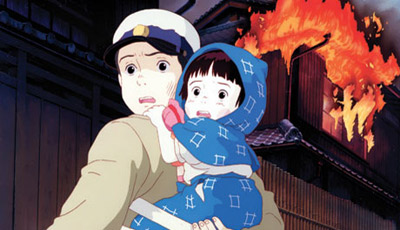
Animation in Japan has a more adult and exalted status than in other parts of the world, in part because they’ve used it to grapple with darker issues than the likes of Disney-Pixar dare touch: politics, metaphysics and of course the defining event of 20th century Japanese history – nuclear annihilation. Whereas the supernatural, end-of-days millenarianism of Akira (1988) was a slightly insane response to the insanity of instantly losing 200,000 citizens from two bombs, Isao Takahata’s Grave of the Fireflies – released the same year as Akira – is something else entirely: a human response to how the war affected two perfectly average children.
The teenage Seita’s mission to take care of his baby sister, Setsuko, in an old bomb shelter after their parents are killed is foolhardy and prideful – you can’t help screaming “Go back to your wicked aunt!” as he ponders eating frogs to stay alive – but it is a kind of genuine heroism that is not reflected in the actions of the film’s selfish grownups. Seita and Setusko watch as the rest of the country slows returns to normal; but their Robinson Crusoe adventure, though doomed, has a joyful purity that damns the hypocritical status quo.
Though Studio Ghibli’s animation may be slightly dated now, it also shows how you can draw what you’d struggle to capture on camera: maggots dropping from burn victims, yes, but also the physical details of a little girl’s life – rocking from side to side to cope with separation from her mother, bravely conserving her three remaining fruit drops by eating only the sticky shards. It’s pathos a four-year-old actor could never convey. You wouldn’t think a film about child starvation would be so uplifting, or so beautiful. Chris Michael
8. The Iron Giant
The Iron Giant
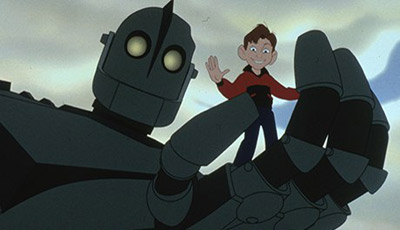
When the new Star Wars films were announced, there was a brief glimmer of excitement when Brad Bird’s name was mooted. It’s not hard to see why. While Mission: Impossible IV and The Incredibles showed that Bird could pull off style and kinetic set-pieces, 1999’s The Iron Giant proved that he’s also got the one thing that’s been missing from Star Wars for over 30 years: colossal heart.
A loose remake of Ted Hughes’s tremendously sad modern fairy tale The Iron Man, The Iron Giant flopped on release. This, plainly, is absurd. The film has been called one of the best non-Disney animations ever made, and the assessment is still hard to argue with.
Hogarth, a young boy, discovers a giant metal robot that has fallen from space, its memory wiped. Hogarth goes about teaching him a uniquely childlike, wide-eyed ideology of the world. The giant learns about good and bad, about death. He becomes a kind of local folk hero, but falls afoul of the military. By the film’s end, after Bird has forced Hughes’s broader themes of courage and pacifism through his own retro-futurist prism, heartstrings will have been tugged and tears will have been fruitlessly fought back.
A true hidden gem in all regards, The Iron Giant was perhaps a little ahead of its time. Five years after its release, Bird had corralled the might of Pixar into making The Incredibles; a flashier film that shares many of The Iron Giant’s core messages. Had he held on for a few more years and given it the full CGI treatment, there’s little doubt that The Iron Giant would have conquered all that stood in its way. Stuart Heritage
7. Yellow Submarine
Yellow Submarine
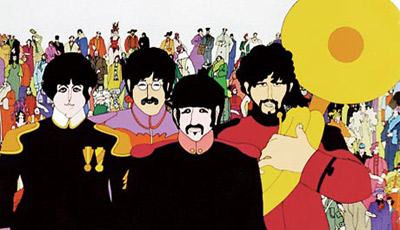
Yellow Submarine was the fourth Beatles film in the space of four years and premiered in the summer of 1968, two years after the band quit touring in a hail of jelly babies (George Harrison’s favourite candy, thrown by screaming fans). Seen in the light of the band’s growing contempt for their publicity machine, this ambitious animation feature not only builds on the conceit of the the Fab Four’s three previous films, in which they played versions of themselves as characters, it takes it to the logical extreme: not only are they not physically in it, they didn’t even voice it.
Following their landmark Sgt Pepper album, and pre-empting the Monkees’ equally surreal Head by several months, the Beatles somehow managed to smuggle the film’s psychedelic aspects past the general public. Indeed, the film was quickly embraced by children, who responded to the simplicity of Lee Minoff’s script, which seems remarkably rich considering he later claimed his only influences were repeated plays of the song Yellow Submarine itself and a meeting with Paul McCartney, in which the moptop expressed his hope that the film would contain “a monster”.
Pitting the band against music-averse killjoys the Blue Meanies, who attack Pepperland and leave it in a state of frozen limbo, the film was directed by experimental Canadian animation producer George Dunning on a budget of just $1m. Dunning’s masterstroke was to install Czech-German illustrator Heinz Edelmann as art director, and it is Edelmann’s pop-art creations that stay in the mind, notably the Eleanor Rigby sequence with its bombed-out Liverpool streets and the abstract brainscapes of Lucy in the Sky With Diamonds. It says a lot about the band’s careful curation of their own image that Yellow Submarine remains their favourite of their three feature films for United Artists. But it perhaps says more that the following year’s Let It Be – the only film to capture the “real” Beatles, on the precipice of a break-up – is currently unavailable on DVD. Damon Wise
6. Persepolis
Persepolis
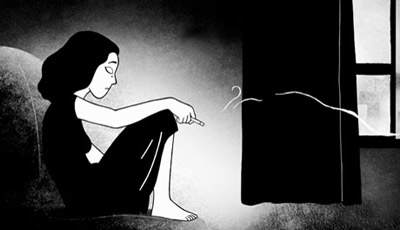
French-Iranian graphic novelist Marjane Satrapi co-wrote and co-directed the film adaptation of her own Persepolis, based on her memories of growing up during the 1979 revolution. Her young on-screen counterpart, Marji, is a spunky, rebellious sprite who worships Bruce Lee, shoots the breeze with God and believes herself to be a prophet. Her family embraces the overthrow of the shah’s regime, but Marji realises that Iran is not changing for the better. Like John Boorman’s Hope and Glory, which offered the definitive child’s-eye view of life during wartime, Persepolis honours its protagonist’s trifling concerns. Even with the Iran-Iraq war escalating and missiles destroying the neighbourhood, Marji’s prime concern is winning a game of “My uncle has been in prison longer than your father”, or scoring a copy of the new Iron Maiden album.
Persepolis brings a lightness of touch to weighty topics, while the drawings capture precisely Marji’s bewilderment at her rapidly changing world. When she visits her dissident uncle in a Gothic prison cell rendered in charcoal smudges, the soft, clear lines of her own body make it seem as if she’s strayed into a more sinister comic book. At school, headscarves and veils transform Marji and her classmates into rows of Russian dolls, peeking timidly from behind each other’s sloping shoulders.
The picture’s back-to-basics visual flair remains wonderfully refreshing. The simple black lines, or the blocks of inky darkness inflected with white detail (such as the silhouetted gas masks with two lunar circles for eyes), are both plain and poetic. Satrapi and her co-director, Vincent Paronnaud, make a little go a long way: the dots of snow falling on a sooty Tehran landscape show that you don’t need to be David Lean to conjure an evocative sense of place. There’s something satisfying, too, about the use of tidy, monochromatic, near-minimalist animation to describe a subject as messy as modern Iran. Ryan Gilbey
Read the full article from the Guardian.