By Michelle Castillo, CBS News
The human papillomavirus (HPV) does not lead to riskier sexual activity among young women, according to new research.
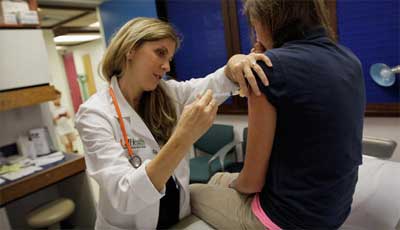
University of Miami pediatrician Dr. Judith L. Schaechter gives an HPV vaccination to a 13-year-old girl in her office at the Miller School of Medicine on Sept. 21, 2011 in Miami, Fla. JOE RAEDLE/GETTY IMAGES
The new study, which was published in Pediatrics on Feb. 2, examined whether young women’s sexual behavior changed after they were vaccinated.
“We hope this study reassures parents, and thus improves HPV vaccination rates, which in turn will reduce rates of cervical and other cancers that can result from HPV infection,” Dr. Jessica Kahn, a physician in the division of adolescent medicine at Cincinnati Children’s, said in a press release.
Previous studies have also showed that the HPV vaccine is not linked to increased promiscuity at an earlier age.
“The findings strengthen a growing body of literature that indicates that getting HPV vaccination is very unlikely to change an adolescent’s perception about risk and also their actual sexual behavior,” Dr. Amanda Dempsey, a pediatrician and vaccine research at the University of Colorado, Denver who was not involved in the new study, told Reuters.
HPVs are a group of around 100 common viruses. The Centers for Disease Control and Prevention believes approximately 79 million Americans are currently infected with an HPV strain.
Two types of HPV — strains 16 and 18 — have been linked to 70 percent of cervical cancer cases, and another two — strains 6 and 11 — cause 90 percent of genital warts.
About 40 HPV strains can be transmitted sexually and have been linked to cancers of the oropharynx (back of the throat, including the base of the tongue and tonsils), cervix, vulva, vagina, penis and anus.
Almost all sexually active men and women are expected to get HPV at some point in their lifetime, according to the U.S. Department of Health and Human Services, although most cases do not develop into cancer.
Read the full article by Michelle Castillo from CBS News.