By Gilles van Kote, Guardian Weekly
Public-health scandals are reported almost weekly by the media in Vietnam. The public is beginning to take notice and so are farmers, including Tran Van Dao, a market gardener and a member of a co-operative in Van Duc, a village on the edge of Hanoi. The co-operative’s produce is certified by VietGAP – meaning good agricultural practices. Launched in 2008, this certification system requires farmers to keep a record of all the pesticides and fertilisers they use. Yearly checks are supposed to be carried out. But it is not proper organic farming.
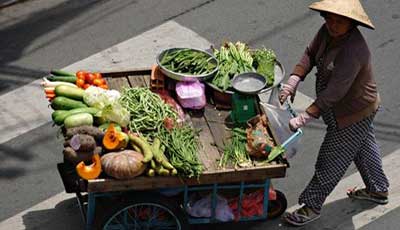
A street vendor pushes a cart of vegetables along a street in Saigon, Vietnam. Photograph: Hoang Dinh Nam/Getty
“The difference from a farmer who’s not certified is that I can only use authorised substances and I also have to leave at least two weeks between the last treatment and the harvest,” Tran says, as he inspects his plot.
To meet demand from the emerging middle classes and the new big retailers, agriculture is starting to adopt minimal standards for environmental protection and public health.
In the 1990s a government “healthy vegetables” scheme was set up that ensured standards for water, air and soil quality.
“With certified vegetables, the environment is protected, output is steadier and prices higher,” says Minh Nguyen Van, deputy head of the Van Duc co-operative. But gains are slight. A certified cabbage may fetch 24 cents a kilo, compared to 19 cents for an ordinary cabbage.
Only subsidised farmers’ groups can afford the cost of certification, which is equivalent to $850 a hectare. Hanoi city council paid for the Van Duc Co-op to get their registration.
Supervision of farming is still fairly haphazard and sanctions almost non-existent. “We don’t analyse everything, because the tests cost too much, particularly for insecticides,” says Nguyen Thi Tan Lo, an economist at the Fruit and Vegetable Research Institute, which works in partnership with France’s Centre for International Co-operation on Farming Research for Development (Cirad). “Often the results come through after the produce has been sold and consumed,” Nguyen adds.
Read the full article by Gilles van Kote from Guardian Weekly.