By Ha Giang/Nguoi Viet
Editor’s note: China’s placement of the HD-981 rig and deployment of vessels in an area Vietnam considers part of the country’s exclusive economic zone and continental shelf has caused tensions between the two countries and worsening conflicts in the South China Sea. What are the implications of China’s actions, and why did Beijing decide to do this now? Professor Carl Thayer of the Australian Defence Force Academy, and an expert about Vietnam, offered his insights in an interview with Ha Giang of Nguoi Viet.
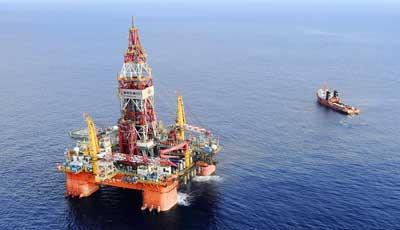
FILE – In this May 7, 2012 file photo released by China’s Xinhua News Agency, CNOOC 981, the first deep-water drilling rig developed in China, is pictured at 320 kilometers (200 miles) southeast of Hong Kong in the South China Sea. Vietnam warned China on Tuesday, May 6, 2014, that it would take all necessary measures to defend its interests in the South China Sea if Beijing does not remove the large oil rig from waters claimed by both countries. (AP Photo/Xinhua, Jin Liangkuai, File)
Ha Giang (NV): In your opinion, why did China decide to bring in to operate drilling oil equipment in a disputed patch of the South China Sea – where Vietnam claims territorial rights — and why did Beijing decide to do this now?
Professor Carl Thayer: China is directly challenging Vietnam’s right to sovereign jurisdiction over resources in its Exclusive Economic Zone. China’s unilateral actions represent a threat not only to Vietnam but to the other littoral states: the Philippines, Malaysia and Indonesia. China’s actions are a reaffirmation that China will seek to gradually expand its presence until it acquires dominance over the entire South China Sea. China is acting now because the Obama administration is seen as weak and incapable of responding.
NV: What else can the Vietnamese government do, or should it do under the circumstances, besides protesting and requesting China to “immediately stop all the illegal activities and withdraw the rig from Vietnamese waters”?
Professor Thayer: Vietnam does not have many options. It can attempt to rally support from ASEAN, but this will only result in a paper statement that will condemn the use of force and coercion but not mention China by name. Vietnam can lobby the maritime powers, including Japan and the U.S., to take a stand. But no one will come to Vietnam’s direct assistance. Vietnam can only play its diplomatic hand. If Vietnam tried to use military force, it would suffer a defeat, and China would conduct propaganda portraying Vietnam as the aggressor.
NV: How do you think this action by China affects other countries in the area?
Professor Thayer: Already, Malaysia and Indonesia have taken steps to shore up their military positions so they can control their maritime jurisdictions. China’s actions will make these countries and the Philippines and Vietnam even more wary of China. These core countries are likely to seek more reassurance and support from the United States. All, including Singapore, will spend more on defense.
NV: Should the U.S react to this event, and if so, how?
Professor Thayer: China has snookered the United States. Its action challenges President Obama to “put his money where his mouth is.” The U.S. may say it will oppose coercion and intimidation to resolve territorial disputes, but it will be unable to assist Vietnam. There is no effective defense cooperation between them. If the U.S. does not exert effective pressure, its credibility will be undermined. China has carefully chosen this incident to expose the gap between reality and President Obama’s rhetoric.