By Zhang Jianhua, Xinhua News Agency
HANOI — “I can only speak in a low voice. We called police, but it seemed they won’t come very soon,” Wen Yong, a Chinese businessman in Vietnam’s southern Binh Duong province, told Xinhua as he recalled the horror on May 13 when the anti-foreign riot started.
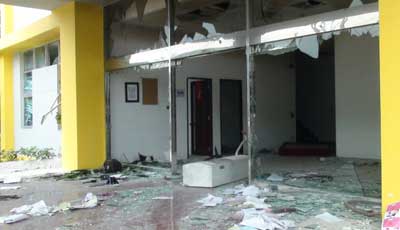
A general view shows damage inflicted upon a factory building in Binh Duong on May 14, 2014, as anti-China protesters set more than a dozen factories on fire in Vietnam, according to state media, in an escalating backlash against Beijing’s deployment of an oil rig in contested waters. Workers looted goods and attacked offices in a rare outburst of public unrest on May 13 in the authoritarian communist nation, which allowed mass anti-China rallies around Vietnam at the weekend. (Photo: VNExpress/AFP/Getty Images)
Like Wen, who owns the Yong Hao Shoe Company in Vietnam’s southern Binh Duong province, many Chinese investors were severely affected by the riot.
At the time, Wen and other Chinese staff were hiding in their upstairs office, as the office downstairs was already ruined by rioters with broken glasses and smashed furniture scattering everywhere..
“Nearly 20,000 people are rioting out there. Police used rubber bullets and tear gas but failed to take control over the crowd,” Wen said.
Security forces had been deployed to Ho Chi Minh City to protect the country’s economic hub, leaving Binh Duong out of control, he said.
“Any Chinese here?” a mobster asked the Vietnamese employees who stayed downstairs. “No, already fled,” came the answer from the employees and Wen breathed a sigh of relief.
Wen, who arrived in Vietnam 10 years ago from China’s southern Jiangxi province and established the company, couldn’t have imagined that his business was attacked three times on May 13. He also could not remember how many rioters had entered his office looking for Chinese.
There was no need to check what happened to his factory, Wen knew by looking outside at the shoe-maker Xiang Hong across the road. Dozens of rioters destroyed the gate, making the way for throngs of motorcycles and people to sack the plant and haul out large boxes.
The riots in central and southern Vietnam have tarnished the country’s image as a safe investment environment.
Since opening its door to foreign investors, Vietnam has offered preferential land and tariff policies to attract foreign investment. After entering the World Trade Organization (WTO) in 2007, foreign investment to Vietnam hit a peak of 71.7 billion U.S. dollars in 2008, but then slid following the global financial crisis.
In 2013, Vietnam lured 21.6 billion U.S. dollars in foreign direct investment, up 54.5 percent year-on-year thanks to the favorable external factors including China’s industry upgrade, which has created many opportunities for its neighbor since 2011, according to government figures.
Taking the textile industry as an example, Vietnam’s 600 garment and textiles companies earned more than 20 billion U.S. dollars from exports in 2013, up 18.5 percent year-on-year, creating five million direct and 2.7 million indirect jobs, government figures show.
During the riots in central and southern Vietnam, Chinese companies including those from China’s mainland, China’s Taiwan and China’s Hong Kong, suffered the most.
Reporters learned that, on May 13 alone, at least 19 companies from those three areas were burned down, 15 of them in Binh Duong.
In addition, 10 companies from Japan, 55 from South Korea and some Singaporean companies were also damaged and forced to close.
Preliminary estimates show the direct losses of Taiwan-funded enterprises in Binh Duong and its neighboring provinces reached hundreds of millions of U.S. dollar, rising to billions if indirect losses are counted.
Taiwan-based Formosa Plastics Group planned to invest 23 billion U.S. dollars in Vietnam’s central Ha Tinh province; however, riots there cost it 3 million dollars, and losses due to construction delays are far bigger.
Read the full story by Zhang Jianhua from Xinhua News Agency.