From Mint Press News
DONG HA, Vietnam — Nguyen Van Thi is a farmer, not a soldier, but with his missing limbs and severe burn scars, he epitomizes the brutal and ongoing aftermath of the Vietnam War.
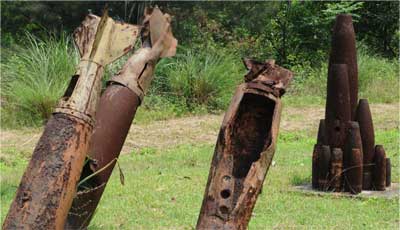
Recovered UXO outside a museum in Dong Ha, where heavy fighting occurred. (Sean Kimmons/GlobalPost)
Thi, 45, found a small explosive while tending to his crops back in 1999. Not knowing what it was, he picked up the device, brushed off the dirt and tapped it with his hoe.
It blew off his left hand.
Then in August last year, he was planting trees outside his village when he struck another forgotten US bomb. This one erupted into a powerful fireball that scorched his legs and eliminated half his left foot and two fingers, fractured his arm and partially blinded him.
“I saw a huge flash and it knocked me unconscious,” said Thi, whose pants caught fire and melted to his charred skin.
The fire quickly roused Thi, who rolled over to snuff out the flames. Then for two hours he lay in agony before an ambulance — scarce in rural Vietnam — transferred him to a district hospital.
Decades after combat against the US ended, Vietnam has resurrected itself as one of the fastest-growing economies in Asia.
Yet it is stricken with mine and bomb victims who lack vital support.
In 2012, Vietnam’s Ministry of Health reported that fewer than 10 percent of survivors were able to access rehabilitation programs.
Introduced in 2010, the country’s mine action plan is years behind other ordnance-infested nations, including neighbors Laos and Cambodia, which were also blanketed with bombs during America’s Cold War-era offensive.
Almost four times more explosives were used on Vietnam during the war than in all of World War II. An estimated 800,000 tons of unexploded ordnance — known as UXO, and consisting of bombs, mines, munitions and other explosives — remain, afflicting a staggering 20 percent of the country, officials say.
If true, that’s more than the 635,000 tons of bombs dropped by US forces in the Korean War.
In Vietnam, US forces used more than 15 million tons of firepower — roughly half from aircraft and the rest on the ground. Historians believe that the US deployed the vast majority of the explosives used during the conflict.
Since the end of the war in 1975, bomb remnants have killed more than 42,000 people and injured at least 62,000 others, according to the government’s preliminary statistics. That death toll exceeds the number of Americans killed in action during hostilities (40,934 — although an additional 17,296 Americans perished from wounds, disease and the like, according to the US National Archives).
Vietnamese officials stress that the number is an estimate. With no national database, UXO incidents cannot be accurately tracked and countless victims in remote areas are overlooked, advocates say.
“There are many more accidents out there that we don’t hear about,” said Hong Tran Chi, country director for Clear Path International (CPI), the main nonprofit group for victim assistance.
Read the full article from Mint Press News.