From The Canadian Press
HANOI, Vietnam – Like thousands of other factory owners in Vietnam, Nguyen Van Phuc relies on China for the expertise and raw materials needed to keep his production line humming. But spiking tensions between Hanoi and Beijing over maritime territorial claims are threatening that relationship and his bottom line.
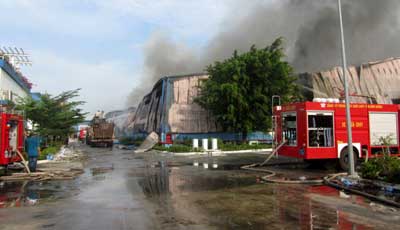
This photo taken on May 14, 2014 shows smoke billowing from a Taiwanese furniture factory in Binh Duong as anti-China protesters set more than a dozen factories on fire in Vietnam, according to state media, in an escalating backlash against Beijing’s deployment of an oil rig in contested waters. The US on May 16, betrayed increasing disquiet over the potential for serious clashes between China and Vietnam over disputed South China Sea territory, calling on both sides to show restraint. (Photo: STR/AFP/Getty Images)
Chinese technicians scheduled to upgrade his equipment are too spooked to visit following anti-China violence. His Chinese suppliers no longer accept cash on delivery, fearing an even sharper deterioration in relations would leave them out of pocket, so Phuc must now pay more from a third-party supplier.
“One hundred per cent of Vietnamese companies just want to have peace to do their business,” he said at his electric cable company in Vietnam’s capital, Hanoi.
China has long feuded with its Southeast Asian neighbours over who owns what in the South China Sea, one of the world’s busiest shipping lanes and a region potentially rich in oil and natural gas. In recent years, Beijing has been more forceful in pressing its expansive claims, bringing it into conflict with Vietnam and the Philippines.
The latest upheaval followed a decision by Beijing on May 1 to plant a massive oil rig in a part of the sea long claimed by Vietnam. Patrol ships sent by both sides to the area have played a cat and mouse game of harassment, with some colliding. Deadly anti-China riots broke out in Vietnamese industrial parks.
While a shooting war on the high seas is still a remote possibility, relations are unlikely to get better anytime soon. With China ignoring Vietnam’s appeals for it to withdraw the rig, Hanoi is threatening an international legal challenge to Beijing’s claims. That carries the risk that China, the world’s second biggest economy, will retaliate economically against its much smaller neighbour, a path Beijing has been willing to go down before with other countries.
Vietnam’s authoritarian rulers are in a difficult position: their legitimacy rests in large part on an ability to deliver rising living standards to the country’s 90 million people. Good relations with China, Vietnam’s largest trading partner, a major source of development funding and an important investor in the textile and power industries, are vital to that.
Yet there is deep anger in the government over Beijing’s latest move, as well as domestic pressure for it to respond. Some analysts are predicting an economic slowdown as a result of the tensions, even as they recognize that Vietnam’s dependence on China means it can’t afford to risk a complete breakdown in ties.
Nguyen Duc Thanh, the director of Vietnam’s Economic and Policy Research Center, said the current tensions could result in a 1 percentage point drop in gross domestic product growth this year due to delays in infrastructure projects, particularly power plants that are being developed with Chinese expertise.
“China is building a lot of them. I don’t think they will totally stop, but they will be delayed. And time is money,” he said.
Other China-linked factors that could drag on growth this year include trade being hurt by tougher customs clearance at the land border, fears of greater instability deterring foreign investment, and a drop in Chinese tourists. Visitor arrivals from China totalled 2 million last year, about a quarter of total foreign visitors.
Read the full story from The Canadian Press.