From City Journal
It’s a sad and intransigent truth that poor children don’t do as well in school as kids whose parents have money. During most of American history, few jobs required more than minimal education, and that fact didn’t cause much hand-wringing. But about 30 years ago, manufacturing jobs began to evaporate, median incomes stalled, and the expanding knowledge economy increased the number and type of cognitive skills needed for most middle-class jobs. Suddenly, the academic performance of low-income kids mattered a great deal. In an age when good jobs require advanced skills, it’s only a slight exaggeration to say that education gaps are income gaps and income gaps are achievement gaps.
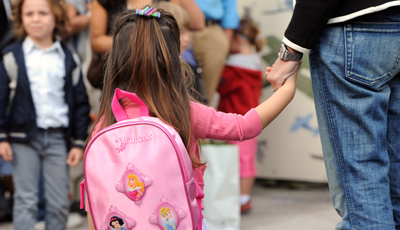
Child and parent getting ready for school. (ANNE-CHRISTINE POUJOULAT/AFP/GettyImages)
As dismay over economic inequality has grown, so has skepticism that culture has anything useful to tell us about how people do in school or in life. “Blaming poverty on the mysterious influence of ‘culture’ is a convenient excuse for doing nothing to address the problem,” Pulitzer Prize–winning columnist Eugene Robinson has written. “If we had universal pre-kindergarten that fed all children into high-quality schools, if we had affordable higher education, if we incentivized industry to invest in troubled communities—if people had options for which they were prepared—culture would take care of itself.”
But skeptics like Robinson are missing something important. No one would argue that such things as hunger, homelessness, a mother’s job loss, a father’s imprisonment, and—sometimes forgotten in this familiar list—a parental breakup have no effect on a student’s ability to learn in school. It’s equally foolish to suggest that culture—the habits, meanings, and aspirations that parents bring to child-rearing—has no effect. America, with its diverse population, has had more than a century to learn this lesson. Now, with record immigration, Europe is learning it as well.
You don’t need to look far to find studies advancing the idea that income inequality explains the educational achievement gap. An influential 2011 volume called Whither Opportunity includes a number of essays showing the educational advantages of growing up rich. “In the early 1970s, the 20 percent of parents with the highest incomes spent approximately $2,700 more per year than bottom income quintile parents on goods and services aimed at enriching the experiences of their children,” write Greg Duncan and Richard Murnane, the volume’s editors. “In the mid-2000s, the corresponding inflation-adjusted difference in enrichment expenditures was $7,500,” they contend, noting that most of it was spent on music lessons, travel, and summer camps. Stanford professor Sean Reardon concluded that the achievement gap between children from high- and low-income families is 30 to 40 percent higher for children born in 2001 than it was among children born 25 years earlier—in part, Reardon claims, because of “increasing parental investment in children’s cognitive development.”
Income is now more significant than race in explaining the educational achievement gap. Reardon examined 19 nationally representative studies going back more than 50 years and concluded that while the test-score and college-graduation gaps between blacks and whites were shrinking, the gaps between rich and poor were growing. The black/white test-score gap used to be about twice as large as the rich/poor test-score gap; today, the opposite is true.
For some, the close correlation between income and school achievement settles the discussion—but it shouldn’t. Inequality headlines drown out the reality that plenty of poor kids go to college and make it into the middle class. True, such stories are rarer than most Americans might like, but 58 percent of American children born into the lowest income quintile will move out of it as adults, and 40 percent will make it into the middle class (defined as three times the poverty line), according to Brookings Institution economist Isabel Sawhill. We know some things about these successful strivers: first, they’re more likely to grow up living with both parents than their counterparts who remain in poverty; second, they’re disproportionately members of certain cultural groups. Chinese, Vietnamese, Russians, and Iranians often make it. Mexicans, Dominicans, and Haitians, among others, often don’t.
This is the point in the conversation when many people—sociologists and educators included—tend to balk. Culture doesn’t lend itself to rigorous, quantitative social science. How do we measure mores, norms, or habits? As economists have become more prominent in poverty and education research, this fuzziness has all but erased the word “culture” from many top journals. Fueling the squeamishness is a fear that generalizations will reduce our understanding of individuals to stereotypes. But while often well-intentioned, those who minimize culture’s significance ignore both ordinary observation and an impressive body of research.
The historical evidence that differences exist in the way cultural groups approach education couldn’t be clearer. In his magisterial series of books on migration among diverse peoples, Thomas Sowell chronicles how various ethnic groups carry educational aspirations with them across time, even as they immigrate to wildly disparate destination countries. German migrants, for instance, always made education a top priority. They built schools in nineteenth-century Brazilian jungle settlements and opened kindergartens on the Wisconsin prairie, despite the subsistence conditions they faced. The education-minded Japanese who settled in rural Brazil tried a different approach. To ensure their children’s future, they sent them away to boarding schools. By 1970, the Japanese made up a mere 3 percent of the Brazilian population but 10 percent of the country’s university students.
Jews, too, have been bookish wherever they put down roots. In the United States during the early twentieth century, for instance, poor immigrant Jews far out-studied their recently arrived Italian neighbors. In his seminal Beyond the Melting Pot, coauthored with Daniel Patrick Moynihan, Nathan Glazer observed that Italians didn’t see the point of education. It was a sensible position to take in an industrial era. Italian girls were expected to help with domestic chores to prepare them for an all-but-certain future as wives and mothers. Boys were expected to work from a young age. “One improved one’s circumstances by hard work, perhaps by a lucky strike,” Glazer wrote, “but not by spending time in a school, taught by women, who didn’t even beat the children.” In the early 1930s, only 11 percent of Italian-Americans graduated from high school, compared with the American average of 43 percent, and over 50 percent of Jews.
Today it would be hard to find a parent in the United States, whether Bill Gates or a burger-flipper at McDonald’s, who would shrug off education as immaterial for a kid’s success. Yet what sounds like agreement doesn’t work that way in practice. It’s a cliché—but one confirmed by ethnographers—that Asians, now the fastest-growing immigrant group in America, are uniquely zealous in their pursuit of education. In just one of many studies, sociologists Jennifer Lee and Ming Zhou interviewed 82 young adult children of Chinese and Vietnamese immigrants. For the respondents, “high school was mandatory, college was an obligation, and only after earning an advanced degree does one deserve kudos,” they wrote. This was “regardless of parental human capital, migration history, and class background.” (Like others who have studied the subject, Lee and Zhou find that Laotian and Cambodian families are exceptions to the generalization; culture critics may well be correct to question the usefulness of the overly broad “Asian” category.)
A blogger of Japanese descent who calls himself the “Financial Samurai” argues, counterintuitively, that what drives Asians is the reality of their outsider status and the inevitable discrimination they will face:
The only people Asian Americans can count on are our immediate family and education. . . . If there is one level playing field among all races, it’s in academics. If you study harder, you will likely get better grades. If you get better grades, you’ll likely get into a better university. If you get into a better university, you’ll likely get a better job and make more money. It doesn’t matter if you’re only 5 feet 1 inches tall, you’ve got the same opportunity as someone 6 feet 10 inches tall in academics. Even if you are poor, so long as you have a stable household you can still study as long as someone who is rich. There is nothing more important to the Asian American population than academics.
Researchers find a different set of priorities among another extensively studied group of outsiders: Hispanic immigrants. Hispanics also talk about getting their kids educated, but they have competing interests. In a 2009 paper in the journal Social Problems, Matthew Desmond and Ruth N. Lopez Turley noted that Hispanics believed strongly in the importance of children remaining at home during their college years—a choice that often leads to lower levels of achievement and a greater reluctance to enroll in higher education in the first place. Likewise, CUNY professor Philip Kasinitz discovered that Chinese children in New York City travel farthest in order to get to the top schools; Latino parents liked their kids to stay closer to home, even if that meant giving up the possibility of attending a prestigious school. (See “Brooklyn’s Chinese Pioneers,” Spring 2014.)
These are generalizations, of course: plenty of Latino parents move mountains to ensure that their children go to the best schools. In her book Opportunity and Hope, Naomi Schaefer Riley tells the story of Jason Tejada, the son of a Dominican couple who saw the disorder at their local public elementary school and sought an alternative. Their determination led them to the Children’s Scholarship Fund, which helped pay Jason’s tuition at a good Catholic school. Surely, the value placed on education by Jason’s parents was one reason he was among the few from his Bronx neighborhood to graduate from an Ivy League college. But surveys suggest that the Tejadas aren’t the Hispanic cultural norm. The Pew Hispanic Center found that while 89 percent of Latino young adults say that a college education is important for success in life, only about half that number—48 percent—say that they plan to get a college degree.
The point is not that the Chinese are better parents than Mexicans or that Ecuadoreans don’t care about education. It is rather that parental priorities differ, and those differences tend to be shared by people with the same cultural backgrounds. Some priorities turn out to be better adapted to an education-demanding knowledge economy than others. A set of Georgian immigrants I know refused to let their son travel two hours every day from their home on Staten Island to Stuyvesant, the elite public high school in Manhattan. Meanwhile, the Chinese kids from his middle school class did just that.
Even in a globalized world, groups of people from similar regional backgrounds raise their children in distinct ways. Pamela Druckerman, an American who wrote about raising her young children in Paris in her 2012 memoir, Bringing Up Bébé, put it this way: “French mothers may not know exactly what they do, [but] they all seem to be doing more or less the same thing . . . [e]veryone from law professors to day care providers, to public school teachers, and old ladies who chastise me in the park.”
Likewise, middle-class American parents have their own unique approach to raising children. Compared with parents elsewhere, including those in other rich countries, Americans put a premium on stimulating, discovering, and fostering their children’s talents and interests from the earliest age. In her 2003 book, Unequal Childhoods: Class, Race, and Family Life, an ethnographic study of white and black middle- and lower-class families with school-age children, Annette Lareau called the middle-class approach “concerted cultivation.” By contrast, low-income parents hew to what she calls “natural growth,” which, as the term implies, means that they don’t feel the need to fuss over their children’s spatial skills or cater to their interest in dinosaurs. Though overall, low-income kids are disproportionately black, Lareau, like Stanford’s Sean Reardon, finds that class trumps race. Black middle-class parents’ child-rearing practices resembled those of their counterparts in the white middle class much more than those of black parents of more modest means.
Read the full article HERE.