By Katy Murphy, Mercury News
SAN JOSE — A San Jose State undergrad grieving the loss of his mother shifted his gaze to outer space and made what could prove to be a remarkable discovery: a system of stars so dense, his professor said, astronomy has no word for it.
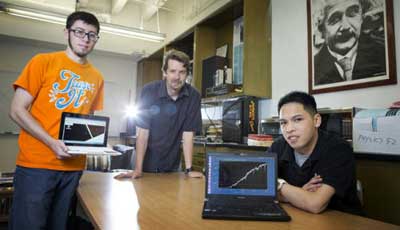
San Jose State University graduating physics major Richard Vo, right, 23, SJSU senior physics major Michael Sandoval, 21, left, and SJSU physics and astronomy professor Aaron Romanowsky, center, in the physics lounge at San Jose State University, May 22, 2014. Sandoval’s laptop depicts a Hubble telescope image of M60-UCD1, a previous record holder for the densest galaxy. Vo’s laptop depicts the spectrum for the object Vo discovered. (LiPo Ching/Bay Area News Group) (LiPo Ching)
In only a week 21-year-old Michael Sandoval stumbled upon what he and his professor have named a hypercompact cluster, which they argue is the intensely starry remains of one galaxy that has been consumed by another.
Astrophysics professor Aaron Romanowsky said it’s astounding how quickly his student may have discovered what “some people take years and never find.”
The stellar search was a welcome diversion for Sandoval, whose mother, Holly Houser, died of cancer in October. In the last years of his mom’s life, the physics major lived at home, juggling her care with his education, sometimes rushing her to the emergency room at night and dragging himself to class the next day from Fremont.
Months later, enrolled in his first astrophysics course, he learned classmate Richard Vo had discovered an unusual stellar object — possibly the densest ever found.
His reaction was immediate: “I want to find one too.”
With free, publicly available data from the Hubble Space Telescope archive and the Sloan Digital Sky Survey, Sandoval set to work on his laptop, combing the universe using some of Vo’s research methods. “I didn’t want to be sitting home, feeling sorry for myself,” said Sandoval, the youngest of two brothers who both took care of their mother after her diagnosis. “That’s not what she would have wanted anyway.”
Instead, he and Vo are rushing to publish their findings with Romanowsky, a temporary staff researcher at UC Santa Cruz before joining the San Jose State faculty in 2012.
Romanowsky was on a team of astronomers from a number of universities that was among the first to discover a dense galaxy like the one Vo found: an ultracompact dwarf galaxy. They published their findings in The Astrophysical Journal in September.
But Sandoval’s search for a similar object turned up something “weird,” Romanowsky said, unlike anything he had seen.
If a dwarf galaxy is like an apple core, Romanowsky said, what Sandoval found is like the seeds.
They are keeping the names and locations of both findings secret until they have been published.
Read the full article by Katy Murphy from Mercury News.