By Paul J. Leaf, The Diplomat
As the U.S. slashes its military budget and faces new and deepening crises across the world, it needs strong partners, particularly in Asia, where regular Chinese incursions threaten the status quo. The U.S. should thus end its ban on the sale of lethal weapons to Vietnam. Doing so will not only strengthen Vietnam and bring it further into the U.S. camp, but could also improve human rights there if the U.S. properly conditions the arms sales.
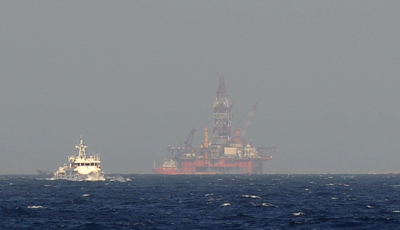
This picture taken on May 14, 2014 from a Vietnamese coast guard ship shows a Chinese coast guard vessel (L) sailing near China’s oil drilling rig in disputed waters in the South China Sea. Vietnam is experiencing its worst anti-China unrest in decades following Beijing’s deployment of an oil rig to disputed waters, with at least one Chinese worker killed and more than 100 injured. (HOANG DINH NAM/AFP/Getty Images)
In 1984, the U.S. imposed an arms embargo against Vietnam because of its poor human rights record. In 2007, the Bush administration eased it, permitting the export of certain non-lethal defense items to Vietnam. Still, Hanoi’s continued human rights abuses have limited Washington’s willingness to draw closer to it. Among other things, Vietnam limits press, speech and religious freedoms, curtails ethnic minorities’ and workers’ rights, and lacks due process and an independent judiciary.
But a changed security environment requires the U.S. to reconsider its remaining arms ban against Vietnam. The U.S., which is reducing its military spending while being pulled into fresh and intensifying conflicts in Eastern Europe and the Middle East, needs strong partners to help it respond to China’s increasingly hostile rise.
China is a growing threat. Its military budget is the second largest in the world and almost surpasses those of the other twenty-four countries in East and South Asia combined. China has used these funds to field an impressive power-projecting arsenal and weapons meant to deny the U.S. access to its surrounding waters and airspace. Confident in its military strength and doubting U.S. resolve, Beijing has been aggressively advancing its claims over contested areas.
Consider its actions this year alone against Vietnam in the South China Sea, where those countries have rival stakes, more than half of world trade passes, and rich fishing grounds and potentially large gas and oil reserves lie. In January 2014, China began requiring foreign vessels to obtain approval to fish in the 90 percent of the 1.35-million-square-mile South China Sea that it claims. From May through mid-July, China deployed a state-owned oil-exploring rig 80 miles inside Vietnam’s 200-mile exclusive economic zone recognized by international law. During that time, China buzzed and rammed Vietnamese vessels trying to intervene, plus it sank another. Last month, amidst U.S. and Filipino requests for all claimants to freeze provocations in the South China Sea, China announced plans to construct lighthouses on islands there to legitimize its purported legal rights to the islets over Vietnam’s. And last week, Vietnam accused China of harassing its fishing boats and beating Vietnamese fishermen near the disputed Paracel Islands.
Read the full article HERE.