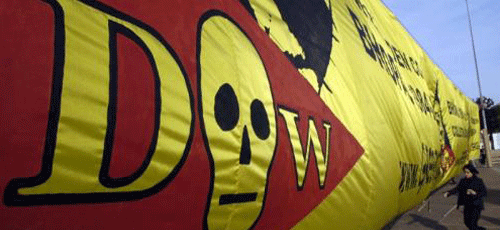
Photo courtesy of www.gamesmonitor.org.
From WIRE REPORTS
His children are 36 and 33 years old, but they look just
like 3-year-old boys who still scream through the night, smash anything they
find in the house, and bite their parents’ hands for comfort.
In 1968, Nguyen Van Tao, from the northern province of
Thai Nguyen, fought to expel the American army from the A Luoi Valley in what
is now the central province of Thua Thien-Hue. The U.S. drenched the area with
Agent Orange for 10 years, from 1961 to 1971.
Tao said he was exposed to Agent Orange and blamed his
sons’ mental and physical health problems on dioxin, a highly toxic chemical in
the herbicide, which U.S. troops used to strip Vietnamese forces of ground
cover and food.
But like up to 4.8 million Vietnamese victims who were
exposed to the poison, Tao has no idea when its producers will pay them the
damages they demand.
“I even don’t know who they [the producers] are,” Tao
told a Vietnamese publication.
But he might soon as Dow Chemical Co., one of the two
major manufacturers of Agent Orange, is all set to crank up its global profile
through a 10-year $100-million Olympic sponsorship.
Right groups, activists, and even politicians have urged
organizers to jettison Dow’s sponsorship of this year’s Olympic Games in London
over the company’s link to an Indian tragedy 28 years ago. About 15,000
residents of Bhopal, India, died in the aftermath of a 1984 gas leak at a
pesticide factory that was owned by a subsidiary of Union Carbide, which sold
the facility in 1994. Dow bought Union Carbide in 2001.
The Vietnamese government has also joined the fight,
calling on the International Olympic Committee (IOC) to rethink its ties with
Dow, the chemical giant.
In a letter sent May 2 to the IOC, Minister of Culture,
Sports and Tourism Hoang Tuan Anh expressed the “profound concerns” of the
Vietnamese government and its people about Dow’s involvement in the London 2012
Olympics given its notorious record of producing Agent Orange.
“What is worth condemning is the fact that, despite
[international opinion], Dow Chemical expressed their indifference and refused
compensation for the victims of the Agent Orange produced by the company, as
well as their responsibility to clean up contaminated areas,” said the letter,
obtained by Vietweek.
The letter called the acceptance of Dow’s sponsorship a
“hasty decision” by the IOC.
American political author Noam Chomsky said it was
“entirely appropriate” for Viet Nam to object to Dow’s sponsorship.
“The use of Agent Orange was a major war crime. The
victims have been largely ignored, another crime,” Chomsky wrote in an email to
Vietweek.
“Responsibility is shared by Dow Chemical,” Chomsky said.
The fact that the Vietnamese government has officially
voiced its opposition could lend more leverage to the thousands of activists who
have been working against Dow all over the world, said Daniel Korschun, an
assistant professor at Drexel University’s LeBow Center for Corporate
Reputation Management.
“[It] cites Dow’s manufacturing of Agent Orange in the
1960s, which broadens the attack on Dow; so far it had been criticized mostly
for the gas leak in Bhopal,” Korschun said.
Hoang
Vinh Giang, general secretary of the Vietnam National Olympic Committee, ruled
out any boycott of the Vietnamese delegation at the London Olympics, even if
Dow remains a sponsor.
“We just hope the IOC will have an appropriate attitude
toward Dow and urge the company to stop evading its due responsibility,” Giang
told Vietweek.
“For how many years has Dow disdained the agonies of
generations of Vietnamese victims?”
The IOC confirmed it had received the letter from the
Vietnamese government.
“The [IOC] does not enter into agreements with any
organization that it believes does not work in accordance with the values of
the Olympic Movement as set forth in the Olympic Charter,” the IOC said in a
statement emailed to Vietweek.
It said it had reached the partnership agreement with Dow
in 2010 and before that, the IOC had “studied carefully” the history of the
company.
The IOC called Dow, which was listed as the second-worst
polluter in the world by the U.S. Environmental Protection Agency in 2010, a
“global leader in its field of business” and said the company was “committed to
good corporate citizenship.”
Scot Wheeler, a Dow spokesman, dismissed the Vietnamese
letter as both “misguided” and “wrongly focused.”
“Under the authority of the War Production Act, the U.S.
government compelled many companies, including Dow, to produce the herbicides
that were used during the conflict,” Wheeler said.
Dow’s vice-president of Olympic operations George
Hamilton also described the company’s critics as “irresponsible” in March.
“This issue is not our issue,” Hamilton was quoted
by The Guardian as saying. “We’re not going to be bullied by activists or
politicians who want to get involved in this, whatever their driver may be.”
Since the Bhopal tragedy, India, Amnesty International,
Greenpeace and some members of the British Parliament have demanded Dow
increase a $470-million compensation package that Union Carbide paid victims in
1989, Reuters reported. The Indian government wants Dow to pay an additional
$1.7 billion, but Dow has refused, saying it has no responsibility for Bhopal
and that Union Carbide settled liabilities, the newswire said.
“So far, Dow has taken a hard line by claiming that the
responsibility for Bhopal lies with others. Dow is taking a bit of a gamble in
this regard,” said Korschun, the corporate reputation management expert.
“By maintaining such a hard line, Dow may inadvertently
contribute to a narrative that it is the bully,” Korschun said.
Tao, the Vietnamese veteran exposed to Agent Orange, said
he did not know who would take care of his sons when he and his wife die. He is
69 and his wife 62.
“I just don’t want to think about tomorrow,” Tao said.
“No people have suffered more from the products of
Monsanto and Dow Chemical ― manufacturers of the infamous Agent Orange ― than
the Vietnamese people,” said John Pilger, a former war correspondent in Viet Nam
and a vocal critic of American and British foreign policies.
“But isn’t Viet Nam itself doing business with Monsanto
or Dow?” Pilger said.
Both Dow and Monsanto have set up representative offices
in Viet Nam. The Vietnamese government has licensed Monsanto to carry out lab
research and tests on the application of the controversial genetically modified
maize in the country.
Senior Lt. Gen. Nguyen Van Rinh ― former deputy defense
minister, chairman of the Vietnam Association of Victims of Agent Orange and a
sitting legislator ― did grill the agriculture minister at a plenary
parliamentary session last November about allowing Dow and Monsanto to re-enter
Vietnam.
But Rinh said the minister had evaded his questions.
Rinh said he would continue asking the government about
this when the National Assembly, Viet Nam’s legislature, convenes its biannual
session this month.
“My ultimate goal is,” Rinh said, “to push the government
to get both Dow and Monsanto out of Viet Nam.”