By Carl Thayer, The Diplomat
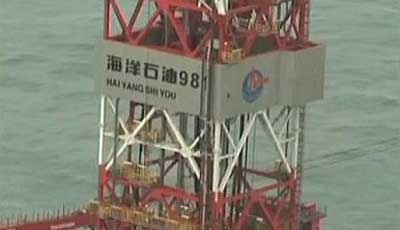
China’s unexpected announcement on July 15 that it was withdrawing its mega oil drilling platform from Vietnamese waters early has resulted in a debate among academic specialists about the reasons why.
China’s oil rig. Image Credit: Wikimedia Commons
Zachary Abuza, a professor at Simmons College in Boston, argues that Vietnam buckled under Chinese pressure, while Alexander Vuving, a professor at the Asia-Pacific Center for Security Studies in Hawaii, argues that Vietnam stood its ground and China blinked.
Abuza’s analysis appeared in the “Speaking Freely” section of the Asia Times on July 29. His analysis was original, provocative and highly speculative.
Abuza argued that China’s placement of the oil rig “presented the most divisive threat in years to Hanoi’s Communist Party leadership.” Not only were members of the Politburo deeply divided, but the majority chose to de-escalate the crisis by accommodating Chinese pressure. “Hanoi’s decision to back down has potential grave implications,” Abuza writes, “Vietnam has effectively appeased China, which will most likely lead to more aggression.” A policy of appeasement, Abuza concludes, “will pose a danger to the regime itself… [and] to the regime’s legitimacy.”
To support his argument Abuza provides some very detailed information about the normally opaque decision-making process by the Vietnamese leadership. Abuza’s argument may be summarized in four points:
First, in response to Chinese assertiveness in placing the HYSY 981 oil rig in Vietnamese waters in early May, Abuza avers that the Vietnam Communist Party’s Central Committee met in June and “unanimously resolved to condemn Chinese aggression and encroachment.”
Second, the visit to Hanoi of China’s State Councilor Yang Jiechi on June 18 proved pivotal. Prior to the visit Vietnam’s leaders hoped that Yang would make diplomatic concessions. According to Abuza, just the opposite occurred. Yang “was anything but conciliatory;” he “berated his hosts for ‘hyping up’ the situation” and warned “bluntly that China would ‘take all necessary measures’ to protect the rig.”
Third, as a result of Councilor Yang’s visit a majority of the 16-member Politburo reversed the Central Committee’s June resolution. According to Abuza, a minority of six members favored “a multi-faceted strategy” of standing up to China, while the ten-member majority favored de-escalating the crisis in order to accommodate China.
The most speculative aspect of Abuza’s analysis is his classification of individual Politburo members into these two groups. According to Abuza, the minority group comprised six members: Prime Minister Nguyen Tan Dung, Chairman of the National Assembly Nguyen Sinh Hung, Ho Chi Minh City Party Secretary and “pro-reformist” Le Thanh Hai, Deputy Prime Minister Nguyen Xuan Phuc, and Deputy Chairs of the National Assembly Nguyen Thi Kim Ngan and Thong [sic] Thi Phong.
The ten-member majority comprised: Party Secretary General Nguyen Phu Trong, party Secretariat members To Huy Rua and Le Hong Anh, head of the party’s Central Inspection Commission Ngo Van Du, head of the party’s Propaganda and Education Commission Dinh The Huynh, Hanoi City party chief Pham Quang Nghi, chair of the Vietnam Fatherland Front Nguyen Thien Nhan, Minister of National Defense Phung Quang Thanh, “probably” Minister for Public Security Tran Dai Quang, and “most likely” President Truong Tan Sang.
Fourth, as a consequence of this policy reversal, the Politburo shelved an earlier decision to take legal action against China, downplayed Vietnam’s insistence on a binding code of conduct in the South China Sea, and cancelled the “well publicized scheduled trip to Washington” by Foreign Minister Pham Binh Minh.
The Politburo decided to sound out Washington on its “level of commitment to playing a role in a potential conflict with China in the South China Sea” by dispatching Hanoi party boss and Politburo member Pham Quang Nghi in Minh’s place.
Abuza concluded that the majority of the Politburo “is unwilling to stand up to China” and that “there is a hope in some quarters that by making concessions on the Paracel Islands, the Chinese will reciprocate in the Spratly Islands.”
Alexander Vuving offers a contrasting view in a commentary entitled, “Did China Blink in the South China Sea,” which was published on the The National Interest. Vuving wrote that the oil rig crisis was “a battle of wills… The party with more resolve may win even if it is the less powerful party. With their respective sovereignties at stake, the two states tested each other’s resolve to see who would blink first.”
Immediately after China placed the oil rig in Vietnamese waters, Hanoi’s leaders sought to negotiate with Beijing. China responded with four preconditions: Vietnam must stop its harassment of the oil rig; Vietnam must drop its sovereignty claims over the Paracels; Vietnam must not pursue legal action against China; and Vietnam must not involve third parties, such as the United States.
According to Vuving, Vietnam’s collective leadership responded by dropping plans to proceed with legal action against China and by postponing the visit of Foreign Minister Minh to Washington. This set the stage for China to undertake “a reciprocal act of de-escalation.”
On July 15 China announced that it was withdrawing the HYSD 981 from Vietnamese waters and, in a separate statement, releasing 13 Vietnamese fishermen it had arrested earlier. Vuving concluded that “Beijing’s actions may look like a tacit bargain, but its real nature is something different.” Vuving noted the symmetrical nature and the fragility of mutual concessions by both China and Vietnam.In other words each party could reverse its actions at any time.
In contrast to Abuza, Vuving considered the motivations of both China and Vietnam in his analysis. Vuving concluded that Hanoi’s deference to Beijing was only “a small portion of the recipe, if any portion at all.”
Vuving argued that up until the oil rig crisis China pursued “salami-slicing” tactics through which Beijing pursued “a delicate balance between assertiveness and restraint so that [its] actions are enough to change facts on the ground but not enough to create a good reason for others to turn decisively against ” it.
In contrast to Abuza who asserted that Vietnam’s leaders capitulated to China and “the United States… did not get involved in a meaningful way,” Vuving concluded the opposite. According to Vuving, China’s bullying led to an unprecedented change in Vietnamese perceptions of Beijing and “together with the threat of a de facto alliance with the United States, they indicate a huge change in Hanoi’s approach to Beijing.”
Further, Vuving noted “the general trend… has added more impetus for several states, including Japan, the Philippines, Australia, India and Vietnam, to adjust their military postures and foreign-policy alignments to more effectively counter Chinese aggressiveness.”
Read the full article by Carl Thayer from The Diplomat.