By Chan Nhu, Radio Free Asia
Vietnam’s revised rules on police investigations to take effect next week are a move in the right direction but are not sufficient to prevent abuse of power, a rights group and activists say.
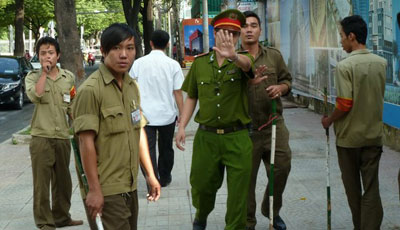
A policeman, flanked by local militia members, guards the outside of the Saigon People’s Court, Aug. 10, 2011. (AFP)
U.S.-based Human Rights Watch said the new policy governing probes carried out by the police, known as Circular 28, is an improvement over past rules, but falls well short of the deep reforms needed to curb “widespread police abuses” in the one-party communist
“If the Vietnamese government is serious about ending police abuses, Circular 28 could provide a good start,” Phil Robertson, deputy Asia director of Human Rights Watch, said in a report.
“But no one should assume that progress can be made unless top levels of the government are wholly committed to ensuring effective police reform.”
Human Rights Watch pointed out that the new rules require further improvements and clarifications of some problematic areas.
For instance, the Ministry of Public Security must specify that each officer’s responsibility before his superiors does not take precedence over his responsibility before the law.
The group also criticized the new policy for emphasizing the role of the commune police, considered the least professional of the country’s police force with the fewest resources and minimal training to handle investigations. The commune police are also known to beat suspects in custody.
Vietnamese police have come under fire in the local media for abuse of suspects, some of whom have died in custody, raising concerns that the abuses are systemic.
In March, a 39-year-old man in the Central Highlands was allegedly beaten to death by local police who were interrogating him for supposedly stealing pepper.
“Local newspapers have reported many similar deaths—some occurring at police stations during interrogations and some after being released—prompting calls for better guarantees of the rights of the accused and for more police transparency,” the state-run Thanh Nien newspaper said when commenting on the case.
Lawyer Nguyen Van Hau, deputy chairman of the Saigon Jurists’ Association, said violations during interrogation could be easily avoided if investigating agencies strictly respected the right of those arrested to seek the services of a lawyer, the newspaper said.
The Criminal Procedures Code stipulates the participation of a defense lawyer at the beginning of investigations except for crimes that can affect national secrets or national security, he said.
Human Rights Watch said the new rules use language that presumes criminality before an individual is found guilty of a crime and limits the role of defense lawyers.
One article in particular says lawyers and their assistants can be subject to disciplinary measures for activities that hinder or “cause difficulties to investigation work,” and the new rules appear to encourage investigators to collect evidence proving that others have caused difficulties to their work.
Read the full story by Chan Nhu from Radio Free Asia.