By Tuan C. Nguyen, Washington Post
Early last year, a little known start-up began posting a series of YouTube videos of a yet-to-be released rifle that enabled those who’ve never even picked up a gun to hit faraway targets with sniper-like precision.
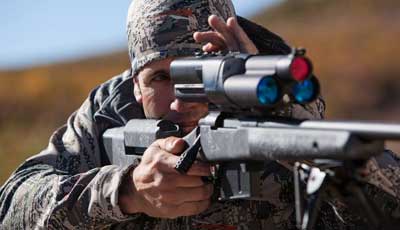
A combination of gyroscopes and accelerometers help to make this rifle especially accurate. (Tracking Point)
By June, the company announced that their initial production run was sold out and U.S. Army officials at Program Executive Soldier, the branch tasked with arming soldiers with state-of-the-art equipment, were impressed enough with what they’ve seen of the can’t-miss technology that they ordered six models for testing. Besides substantially reducing the need for training, the specialized rifles can also cut down on the amount of wasted bullets, potentially translating to lower ammunition costs.
Since then, Austin-based TrackingPoint has unveiled a second-generation version of their precision-guided firearm system that better compensates for its tendency to lose accuracy in extreme temperatures while also being more affordable, with the introduction of a $10,000 base hunting model. They’ve also added a semi-automatic option.
And in a new display of the rifle’s pinpoint prowess, uploaded last week, the team showcased how the technology can be used to score a clean hit on objects as small as a smartphone from distances as far off as a kilometer. The video demonstrated that, even with the painted target area narrowed to a radius of only a few inches, the device, an HTC One, never really stood a chance.
“Most experienced shooters have much better accuracy after their initial shot. But the problem, especially with hunting, is that they often don’t get a second shot,” explained Oren Schauble, the company’s director of marketing. “With our rifles, the chance of hitting your target no matter how small and at extremely long range the first time around is as high as 80 percent.”
“It’s not impossible to miss,” he added, “but it’s close.”
To grasp how the system works, it’s important to note that there’s nothing particularly special about the rifles themselves. In fact, the .300 Winchester Magnum rifles are manufactured by Surgeon Rifles in Prague, Okla. All the company did, essentially, was to modify them with a tracking system that allows shooter to easily “tag” both stationary as well as moving targets (up to 10 mph) with a laser rangefinder that’s visible via a mounted LCD display, much like the lock-and-launch missile systems fighter jet pilots use to take down enemy planes.
Read the full article by Tuan C. Nguyen from Washington Post.