By Sahra Vang Nguyen, Huffington Post
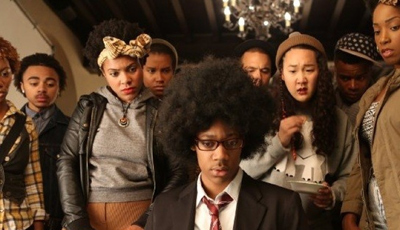
Dear White People reminded me that race is too often framed as a dichotomous conversation of black vs. white. It’s not. Taking place on an Ivy League campus (where Asian Americans are commonly enrolled in high numbers), there was only one Asian-American student seen on screen — named Sungmi — playing the role of the token Asian hanging out with predominantly black students.
Taking place on an Ivy League campus (where Asian Americans are commonly enrolled in high numbers), there was only one Asian-American student seen on screen — named Sungmi — playing the role of the token Asian hanging out with predominantly black students. (Photo from Huffington Post)
When the film culminates in the racist incident of the campus blackface party, I watched in solidarity while reflecting on similar racist events where students threw “Asian-themed” parties and dressed up in Asian stereotypes, such as this frat party at Duke University in 2013. It was absolutely enraging; together, black and Asian-American communities could align on the side of anti-racism.
That same year, an Asian-American fraternity at UC Irvine released a video with an Asian-American student performing in blackface. Whether these students were aware of it or not, their actions made it clear that they were aligning on the side of anti-blackness.
These two examples alone illustrate the fluid positioning of Asian Americans in the racial dialogue. As a marginalized community of color, Asian Americans can stand against racist systems that condone anti-blackness. As a community of color with lighter shades of skin color and framed within the “model minority” myth, Asian Americans can be complicit in anti-blackness and collaborate in the perpetuation of systemized racism.
Perceptions of race are constantly changing, since race is not biological. Rather, it’s a social construct created to establish systems of oppression based on the appearance of skin color — with whiteness being endowed with the most power and privilege. Thus, Asian Americans with lighter skin share privileges in a system that benefits whiteness. Asian Americans with darker skin (primarily Southeast Asian and Pacific Islanders) still face discrimination based on skin color and appearance. At the same time, Asian Americans share a history of oppression with other marginalized communities of color — including deportation, Japanese internment camps, hate crimes (e.g., Vincent Chin) and police brutality (e.g., Fong Lee).
Read the full article HERE.