Hoang Anh Nguyen
BIDONG, Malaysia–In June 1980, my father and I escaped from Vietnam in search for freedom but most importantly, for a better life for us and a brighter future for me. At the time, I was only 13 and scared. I didn’t know if I ever would see my mother, sister and brother again.
After four horrific days in the ocean and enduring the brutality of Thailand pirates, we finally reached Terengganu, Malaysia. There, we were quickly transferred to a small island called Pulau Bidong, one of many small islands that belong to the state of Terengganu.
 |
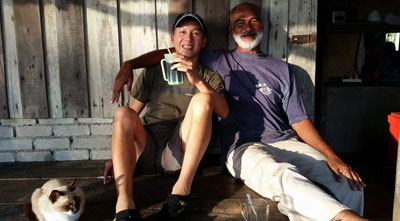
My good Malaysian friend Anuar Ngah and I sharing our passion for flying over Terengganu. |
In 1978, when the number of Vietnamese refugees hit a peak, thousands of so-called Vietnamese “boat people” reached the shorelines of Malaysia every day. There weren’t enough camps to house so many boat people, so the federal government of Malaysia decided to temporarily take custody of Bidong from the state of Terengganu.
The island officially opened as a refugee camp on Aug. 8, 1978, and this was where “Bidongers” stayed and waited to be resettled to another country. On any given day, Bidong had at least 20,000 residents and sometimes reached 40,000. By the time it closed in 1991, the island had welcomed more than 250,000 boat people and delivered 2,000-plus babies at Sick Bay Hospital. After the final refugee left the island on Oct. 30, 1991, the camp closed permanently and Pulau Bidong was handed back to the state of Terengganu.
|
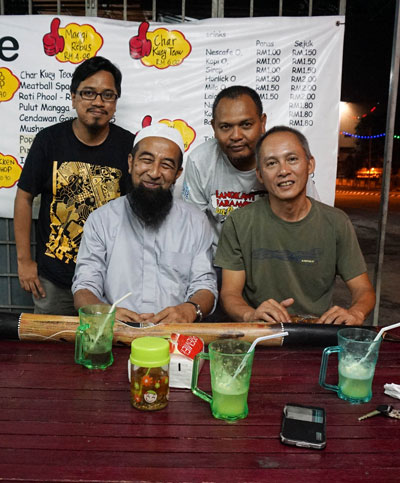
Ustaz Azhar Idrus sharing a few jokes after dinner |
If you ask Bidongers how they feel about Pulau Bidong, they would tell you that Bidong is a very special place that they will never forget. Even though boat people called it Bidong Bi Dat — tragic Bidong — most would tell you that it was anything but tragic. Other words people would use to describe Bidong were: freedom, hope, future, peaceful, beauty or unforgettable. If you ask Bidongers if they ever would want to return for a visit, I am sure the majority would love to take the trip.
|
Skipper Pok Anan used to take boat people to Bidong from Merang
|
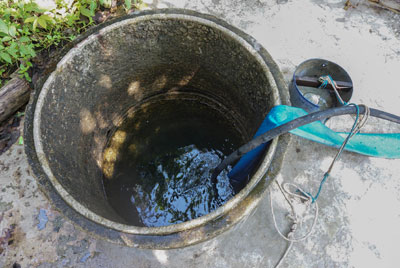
For many years after the close of Pulau Bidong refugee camp, the island became deserted. All buildings, long houses and huts had been demolished. Only fishermen stopped by for a break and took shower using wells left behind by Bidongers. Since 1999, only a few Bidongers have made it back to the island for a visit. A boat ride from Terengganu to Pulau Bidong takes about 30 to 40 minutes. A visitor can get a tour package that includes a hotel stay and a day tour to the island from local tour operators or just go to the city of Merang — which once was a landing zone for many boat people, including me — and hire a small boat with a skipper who would be happy to take them to the island for a very reasonable fee. That was exactly what I did, and this is my story of my journey back to the island that I called home 35 years ago.
|
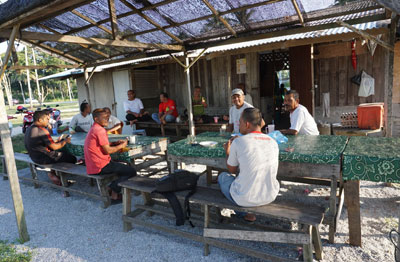
Local fishermen from the fishing village of Merang welcomed me at breakfast |
Like many other Bidongers, I dreamed that one day I could take my family to Pulau Bidong for a visit. And like them, I wished my children could see it with their own eyes and experience how we managed to live without TVs, cell phones and iPads for a long time.
I searched for years but wasn’t able to find a way to get to Bidong until recently when I joined a group on Facebook called Pulau Bidong Alumni. The group’s main purpose was to help Bidongers reconnect with long-lost friends, families or relatives, but it also was for members to post photos of Bidong and share memories among one another.
|
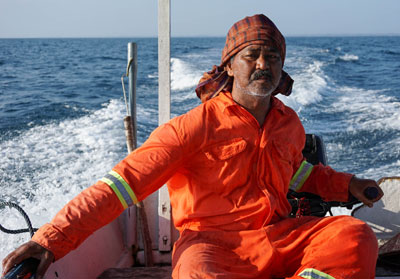
Fisherman Jantan bin Abdullah who I hired to take us to Bidong |
After I joined the group, I was introduced to a member who was neither a Bidonger nor a Vietnamese boat person. He was a Malaysian man who lived in Merang as a young boy. His name is Anuar Ngah, and he has much love and passion for the Vietnamese boat people — especially Bidongers — because he had witnessed boat people landing on the shores of Merang near his house and immediately taken to Pulau Bidong by boats. He often walked along the beach, stared at the island, and wondered what would happen to those boat people. So he began to travel frequently to the island in recent years to learn more about Bidong and whatever history boat people left behind. As his love for Bidong grew, he started to take a few members of the alumni group back to Bidong for a visit.
|
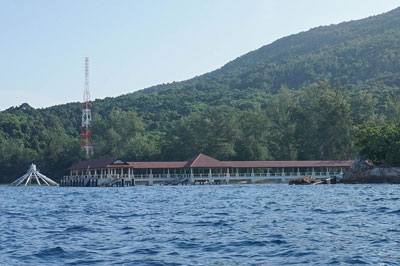
The new jetty at Bidong. The communication tower was just put up recently |
In August. I joined a group of 47 Bidongers from Australia, Canada and the United States to visit the island. Anuar drove us five hours across the mountains from Kuala Lumpur, Malaysia, to Terengganu. Through the travels, I realized I had met a wonderful person in Anuar. We had so many things in common, and he made sure I had the time of my life in Malaysia.
The next morning, Anuar took me to the fishing village of Merang for breakfast and to meet the fishermen who used to witness boat people landing on the shore of Merang. They told me that every day, they would see boats came to shore. The boats then were deliberately sunk a few meters from shore, forcing people to swim to shore. The fishermen would run to the beach to help pull the weak ones to shore and give them food and water before calling the authorities.
|
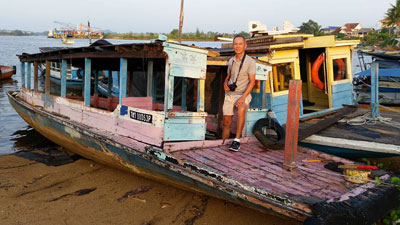
These boats were used to take boat people to Pulau Bidong. Some are still in service today. |
I also met Rohani Bin Abdullah — known to the locals as Pok Anan.– one of the fishermen who used to take boat people from Merang to Pulau Bidong. He is 61 now, and he told me that when he was a fisherman in his late 20s, he didn’t make much money by fishing. He made just enough to feed his family until the government called for the assistance of fishermen. If they had boats, they could load people on the boats and take them to Pulau Bidong for about $15 U.S. a trip. He ran about four trips a day for three months straight to deliver boat people to Bidong.
He made the kind of money that fishermen could never make.
I wanted to ask him to take me to Bidong for one final visit, but he has retired and no longer owned a boat. But while eating breakfast, I met the local fishermen from the fishing village of Merang, and we took a boat ride to Pulau Bidong. We hired a 57-year-old fisherman named Jantan bin Abdullah and paid him 300 Ringgit — about $75 — for a whole day. He was happy to take us anywhere we wanted to go because at his age, he would be lucky to make 300 Ringgit in a week.
|
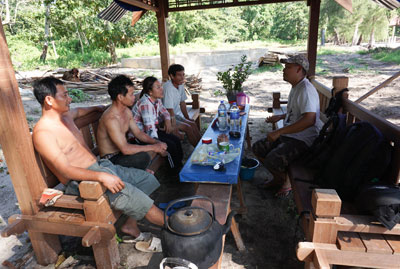
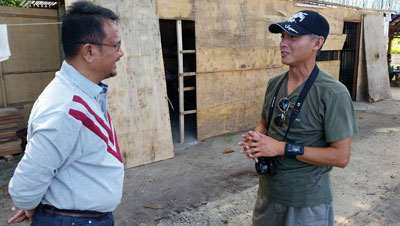
Group of Vietnamese construction workers from Hanoi chatting with Anuar
|
The water was calm in the early morning so Jantan was able to go almost full speed, taking us to the island in less than 30 minutes. As we got farther out to sea, my memory of the 1980s “great escape” suddenly came back, and I was nervous for a moment. When I saw a big ship in the distance, I thought about how Thailand pirate ships would approach on my trip to Bidong 35 years ago. A few pirates would climb aboard my small boat, swinging their machete in the direction of the boat people. Luckily the big ship was getting smaller and smaller and disappeared on the horizon.
|
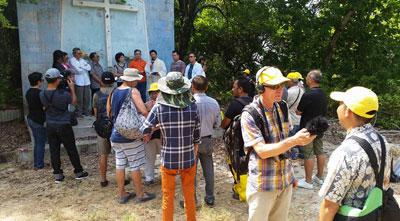
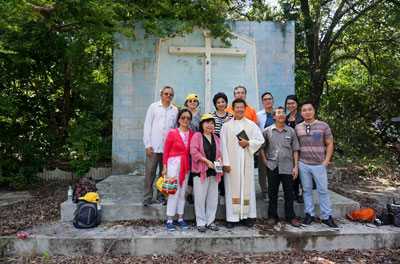
Delegate from the U.S., Canada, and Australia standing in what used to be a Catholic church. |
After the uneventful ride on a small boat, we finally reached Pulau Bidong. Before we docked on the newly constructed jetty, I glanced around the island, snapped a few pictures, took a deep breath of fresh air, and began to process all the good memories I had during my six-month stay. I got goosebumps when I stepped on the jetty, thinking back to the day I first stepped on the old jetty 35 years ago with security personnel telling us to line up, members of the United Nations of High Commissioner for Refugees (UNHCR) greeting us with speeches I didn’t understand, and members of the Malaysian Red Crescent Society (MRCS) passing out snacks, water and some clothes. I also remembered looking toward the beach, where a crowd of Bidongers anxiously waited to see if they could recognize any of us new Bidongers.
|
Father Tuan Pham was a Bidonger in 1981 when he was only 13 years old. |
All of those images in my head are now long gone. The old jetty is gone. No one greeted us, except the fishermen who stopped for a break. The loud noise on the beach that came from Bidongers asking us where we sailed out of Vietnam had been replaced by the sound of the ocean waves gently crashing onto the soft white sand. All the makeshift huts, the longhouse, and the Sick Bay Hospital near the jetty were thee no more. All had been replaced by tall trees and bushes.
|
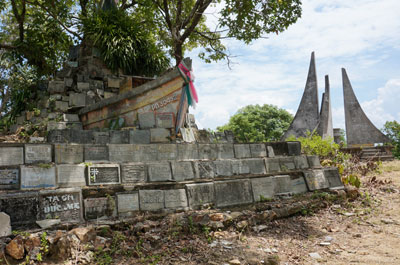
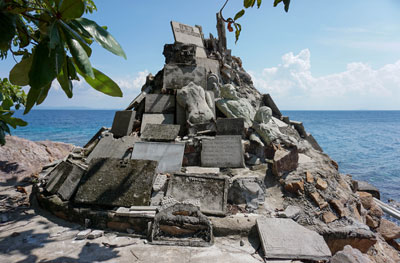
These two monuments are very much in tact |
As I exited the jetty and walked toward Zone G, where I had lived for six months under a two-story hut, I met a group of Vietnamese who had built a small hut and had been living there for a while. I approached them and started asking questions. To my surprise, they said they were construction workers from Hanoi. They were hired by a Vietnamese contractor and had been there for two months laying the foundations for a couple of buildings. One was going to be a church and the other was going to be public toilets.
|
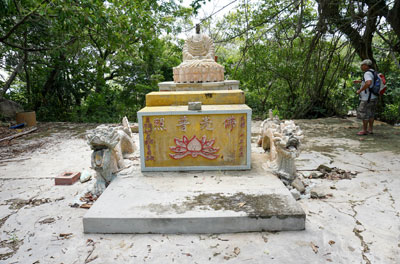
This area used to be a Buddhist temple. |
I asked if they knew who the investors were and learned the investors traveled the world from site to site to build whatever the contractor asked them to do. The only rumor they had heard was that there was a group of investors from Australia who wanted to buy parts of the island to build a resort. In contrast, the officials from the state of Terengganu said there had been no talk about building a resort on the island. They wanted to preserve the relics and whatever structures were left behind by Bidongers and turn the island back to its pre-1978 pristine condition.
|
This area used to be Cao Dai temple.
|
The Vietnamese workers invited me to stay for some tea so I did not hesitate. As we sat in the little hut drinking tea, I started asking them questions regarding their lives, jobs and impressions of Pulau Bidong. They told me there were about 30 of them from Hanoi and most of them were in the 20s and 30s. Some brought their spouses along to cook or do other light chores. They traveled in groups anywhere the boss took them, and they worked throughout the year without a break. They earn about $25 U.S. per day — much more than what they could get in Vietnam. They were homesick but because of the money, they just tried to keep busy so that they didn’t have time to think about home.
|
Statue of Buddha without his head facing the beach at Zone C |
Their impressions of Bidong were very depressing. There was nothing for them to do here after work. Interestingly, they had a generator for electricity and smart phones to keep them informed of current events or to watch movies online.
After tea and a bowl of beef noodles offered to us by the Vietnamese workers, the delegate of 47 Bidongers from the U.S., Canada and Australia finally arrived in two large boats. With a full stomach, I was ready to venture with the group around the island. The group also brought in six Buddhist monks from Australia and a priest from the U.S. While the Buddhist monks prayed at the jetty, I followed the delegate up to the Religious Hill (Doi Ton Giao) where a Buddhist temple, a Cao Dai temple, a Catholic church and a few monuments once covered the entire hill top. The only thing left standing from the church was the back wall with the crucifix attached to it.
|
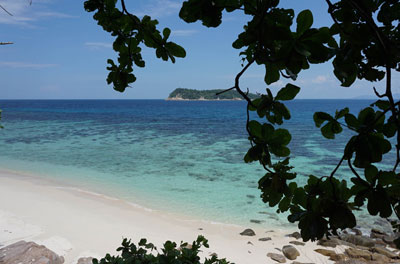
Zone C beach was the nicest beach on the island with great view of Shark Island. |
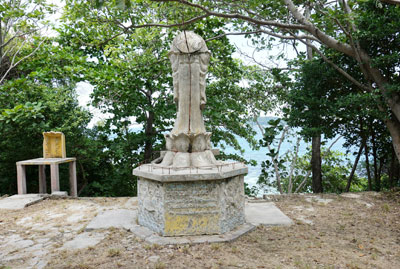
Father Tuan Pham, who is the current pastor of the Holy Spirit Church in Fountain Valley, Calif., began a mass with about a dozen Catholic members. The Buddhist temple was gone except for the statue of Buddha, which remained standing — minus its head. There was a statue of an old man pulling his daughter out of the ocean but it had been vandalized by local fishermen.
|
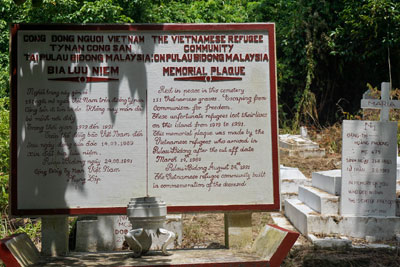
Memorial plaque at the cemetery. The graves were repainted by a group of volunteer Bidongers. |
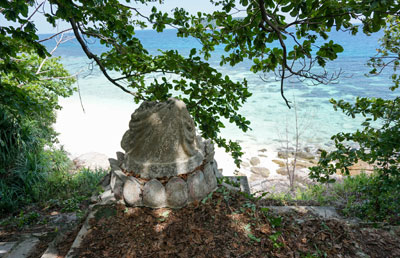
This statue was the most symbolic piece of art on Pulau Bidong because it symbolized the will, the power and the endurance every boat person had to have to survive the search for freedom. Many people have sent letters to the officials of the state of Terengganu for permission to repair the statue with their own money. State officials are still reluctant to allow the repair because Malaysia has strong ties with the Vietnam government, which has asked for the destruction of all things related to boat people.
|
The most symbolic statue called “Ong Than Bidong” or “Ong Gia Bidong” had been vandalized. |
The only monuments still intact were the artificial boat and the sails near the Buddhist temple to commemorate those who made the journey as well as to pay tribute to those who gave their lives at sea in search for freedom. Also, there were cemeteries on the hill. Some graves had been dug up; others had been repainted by a group of Bidongers who had volunteered to come in 2013. I continued to follow the delegates through Zone C and Zone F. All the group members were very emotional when they talked about what they used to do around a specific area. Some shed tears as they thought about the times they were here, and some shared happy memories with laughter.
|
One of several wells dug by Bidongers. Still usable today.
|
As I departed Pulau Bidong and headed back to Merang, I kept looking back at the island feeling very happy and satisfied with what I expected to see and what I saw. The cool breeze hit my face, and I felt like the souls were calling me from the graves up on the hill to invite everyone to come back and visit them more often. Chills started running down my spine as I looked back at the hill. I nodded to them with a promise to send their message to the world.
|
Deputy Director Che Muhamad Azmi Bin Ngah and I had a casual conversation. |
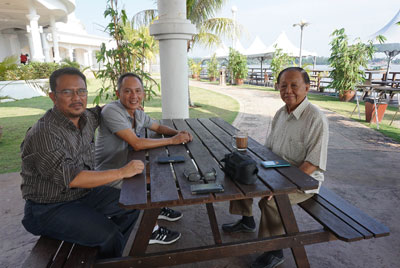
Through one of my new friends, I met Tok Teng Sai, a former chairman of the Malaysian Red Crescent Society who was responsible for bringing food, water, clothing and whatever else the boat people needed to Bidong. We shared breakfast — and stories — with him. He said the reason we had chicken every week was because of him. He was criticized for buying all chicken available in Malaysia and sending them to Bidong for the refugees; I thanked him on behalf of all the boat people who stayed on the island for his tireless efforts and dedications in supporting the refugees at Pulau Bidong.
|
Deputy Director of Terengganu Museum and former Chairman of MRCS having breakfast with me. |
I also shared with the people I met the story of Orange County and its large population of Vietnamese. I proudly told them that we even have two Vietnamese mayors in Orange County. To their delights, they wanted me to send a message to the Vietnamese community everywhere in the world and specifically here in Orange County that they sincerely invite all Vietnamese abroad, especially all Bidongers and their families, to visit the state of Terengganu and Pulau Bidong.
It was especially important to him for us to tell the next generation about the history of boat people and this magnificent island. Deputy Director Azmi also added that even many Malaysians don’t know that Pulau Bidong existed. One thing he said he hoped to accomplish was the establishment of a “friendship” relationship with the cities of Westminster and Garden Grove, where he believes many Vietnamese have left their marks on his beloved Pulau Bidong.
I agreed to share the idea when I got home, and off I went to the airport.
—