By Tony Dunst, Tribune Content Agency
The World Series of Poker Main Event is the most watched televised poker tournament in the world. There has been much debate about whether delaying the final table until November has improved or diminished the broadcast.
JC Tran going head to head at the 2013 World Series of Poker. Photo taken from Youtube video by edonvanasseldonk.
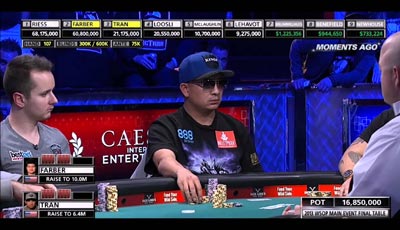
I’m indifferent on the matter, but what I know for sure is that the delay — and the almost-live broadcast it enables — adds another layer of strategy and pressure to the final table. It was hard enough to live with botching a hand at the final table, but now players can still be alive and read tweets calling their play “an abomination and insult to the intelligence of poker players everywhere” just minutes after it happened.
I only watched some of the final table this year, but I followed Twitter throughout the broadcast, and there was an explosion of criticism over a big hand between J.C. Tran and Jay Farber.
Tran entered the final table with the chip lead and the most impressive résumé, making him the popular favorite to win the tournament. But after losing half his stack leading up to six-handed play, Tran committed a major error in his big hand with Farber.
With blinds of 300,000-600,000, Tran raised to 1.4 million from the small blind with Ac Qd and a stack of 21 million. Farber was in the big blind with a stack of 60 million, and with his 6s 6d he reraised to 3.1 million.
Tran thought for a moment, then reached for a tall stack of chips and raised to 6.4 million. The raise sent Farber deep into the tank, and he alternated between looking over his chip stack and trying to evaluate how much Tran had in front of him. Then, Farber announced a raise to 10 million, a wager that represented nearly half of Tran’s stack.
Read the full article by Tony Dunst from Tribune Content Agency.