From WIRE REPORTS
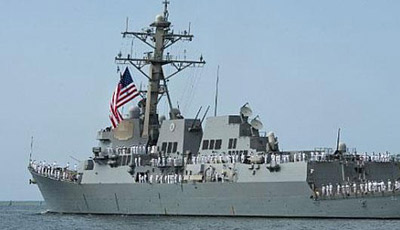
USS Chung-Hoon Photo by Naval Today
The U.S. Navy destroyer USS Chung-Hoon and the salvage ship USNS Salvor docked Sunday in the central Vietnamese port of Tien Sa, considered a strategic deep water harbor in the South China Sea, where China is rapidly expanding its military, economic and civilian presence.
China and four members of the Association of Southeast Asian Nations (ASEAN) – Viet Nam, the Philippines, Malaysia and Brunei – are embroiled in sovereignty disputes over the South China Sea, known locally as the East Sea.
Rear Adm. Thomas Carney, Col. Paul Schilse and U.S. vice consul general Robert Ogburn attended a welcome ceremony at the Tien Sa port, where local officials greeted the American crews.
The Vietnamese representatives expressed their hopes that the cooperation between the Vietnamese and U.S. navies would develop well.
This is the second deployment of USS Chung-Hoon to Viet Nam. It made a port call to Tien Sa port in 2011, joined by the destroyer USS Preble and salvage ship USS Safeguard.
The visit of the two U.S. vessels is part of the 2013 cooperation program between the two navies.
Under the program, the two navies will focus on non-military activities;exchange expertise in controlling and maintaining equipment and vehicles; and share information and experiences relating to humanitarian aid, natural disaster relief, dive training and underwater rescue and medical aid.
A U.S. warship designed to fight in coastal areas also arrived last week in Singapore as part of a tour of Southeast Asia, a move analysts have said underlines President Obama’s new strategic focus on Asia.
Since President Obama announced a “pivot” toward the economically resilient Asia-Pacific region in late 2011, the U.S. has maintained it will play a neutral role in the South China Sea dispute.
But critics say the U.S. leaning toward Asia in foreign and defense policy already has rattled the region and increased tensions between the two superpowers.
According to a white paper on national defense issued last week, China said it was uneasy with what the United States has called the “rebalancing” of forces as Washington winds down the war in Afghanistan and renews its attention further east.
China says the policy has emboldened Japan, the Philippines and Viet Nam in longstanding territorial disputes with Beijing, Reuters said.
China’s Ministry of Defense said in its annual white paper that the country faces “multiple and complicated security threats,” despite its growing influence, adding that current U.S. strategy means “profound changes” for Asia.
Analysts say China always is cautious about any enhancement of the U.S. military presence around the sea.
“The U.S .military pivot toward Asia more generally, including for example, the deployment of combat ships to Singapore and increased U.S .military exercises with regional navies, only serves to add to China’s threat perceptions,” said Sam Bateman, a maritime security expert at the S. Rajaratnam School of International Studies in Singapore.
“In many ways, China is faced with the classic security dilemma: its actions in response to its threat perceptions may only lead to increased threats,” Bateman said.