Nguyen Dieu Tu Uyen/Bloomberg
Vietnamese entrpreneur Nguyen Thi Phuong Thao is poised to become Southeast Asia’s first self-made woman billionaire known for putting bikini-clad models on her VietJet Aviation Joint Stock Co. planes and calendars. With the initial public offering of Vietnam’s only privately-owned airline, Thao is set to have a net worth exceeding $1 billion, making her the country’s first woman billionaire.
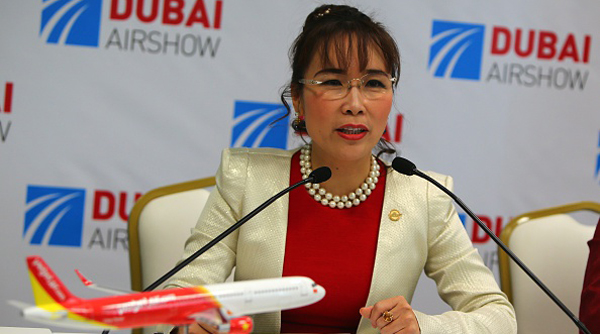
Nguyen Thi Phuong Thao, President and CEO of Vietnamese airline carrier Vietjet, speaks during press conference in Dubai on November 10, 2015. Vietjet signed a deal with Airbus at the Dubai Airshow on Tuesday to buy 30 single-aisle A321 planes worth a total of $3.6 billion. (AFP)
Thao said she’s planning for VietJet to hold its IPO as early as within the next three months, where it may sell as much as a 30 percent stake. The carrier is aiming to seek a valuation of more than $1 billion, according to two people with knowledge of the plan, who asked not to be named because the information is private. Thao, who founded the airline, owns 95 percent of the company.
The valuation it’s seeking in the IPO will make it more valuable than South Korea’s Asiana Airlines Inc. or Finnair Oyj. VietJet’s revenue tripled to $488 million last year.
Thao’s budget airline flies to 47 locations in the country and across Asia, including Seoul, Bangkok and Singapore. She wants to make the company the “Emirates of Asia,” modeling after the success of the Dubai-based carrier that’s the world’s biggest long-haul airline with flights to about 150 destinations.
Thao’s foray into business began around 1988 as a second-year student in Moscow, where she was studying finance and economics. She began as a trade distributor with little money, receiving clothing, office equipment and consumer goods on credit from suppliers in Japan, Hong Kong and South Korea, and selling them in Russia in the years before collapse of the Soviet Union.
After making her first million three years later, Thao moved on to trade steel, machinery, fertilizer and other commodities.
She returned to Vietnam and invested in Techcombank, also known as Vietnam Technological and Commercial Joint-Stock Bank, and a second lender, Vietnam International Commercial Joint Stock Bank. She later lodged an application to run an airline in anticipation the communist government, which adopted a market economy in 1986, would open up the industry to compete against state carrier Vietnam Airlines.