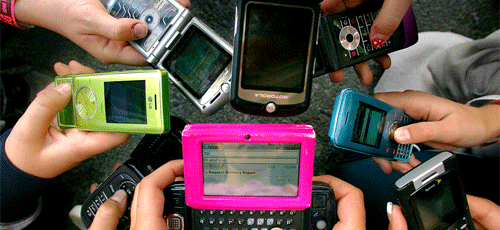
Photo courtesy of www.debaird.net
By ANDREW LAM, New
A sign of the communist nation’s rising affluence, it is also undermining the state’s monopoly on information.
For years
Now, with phones available for as little as $20, ordinary consumers are buying up phones that otherwise would have been bound for foreign shores.
According to the latest statistics reported by TechniAsia, there were 145 cell phones for every 100 Vietnamese in 2012. For a country with a population of just more than 90 million,” it adds, “that amounts to more than 130 million mobile phones.”
And buyers aren’t limited to the middle class. Everyone has them, from elementary school kids to impoverished pedicab drivers. Teenagers have them, too, of course. On motorcycles, Vietnamese chat on their mobiles while weaving dangerously through traffic with one hand on the handlebar. They don’t even turn them off in movie theaters. In cafes, at restaurants, they have a rude habit of talking to you while looking down to check and send messages.
For the government in Ha Noi, which maintains a vigorous Internet firewall similar to the one in
Because beyond the daily chitchat, Vietnamese are increasingly using their hand-held devices to document and share scenes that authorities would prefer remain out of the public spotlight. Police wrongdoings are routinely reported, tweeted and shared online. Protests against police corruption and government land confiscation, and even against
A case in point: The world-renowned venerable monk Thich Nhat Hanh, long exiled in
But the enthusiasm threatened local authorities, who feared a Vietnamese Falun Gong-style movement. The result was a government-sponsored mob attack in October 2009 that resulted in the injuries and arrests of monks and nuns, and eventually the demolition of the newly built temple and dormitories.
While mainstream news in
But no more. Internet access went from 200,000 users in 2000 to 30.1 million users in 2012. Facebook entered the country last year and has quickly captured 10.5 million users, or nearly 12 percent of the population.
“The growth of the Internet is endangering the government,” Le Quoc Quan, an internationally renowned lawyer and democracy activist whose popular blog pushes for a multiparty system and more human rights, told the Associated Press last year. “People can actually read news now. There is a thirst for democracy in our country.”
More and more people are blogging their frustrations and anger. But whether or not the general population does in fact thirst for democracy and want revolution is not clear. It’s a citizenry that has no organized opposition, no charismatic leadership that could challenge the status quo, and no serious conversation on a new national direction.
And despite the urgings of leading activists like Dr. Nguyen Dang Que, who before his arrest in 2011, posted online a call for young people to use their cell phones to make a “clean sweep of Communist dictatorship,” it’s far from certain that ordinary cell phone users perceive the new technology as a potential tool for revolution, a la the Arab Spring.
What is clear, however, is that the wind of change is blowing. There’s a growing collective discontent against injustices and corruption, and the new communication architecture has loosened the tongue of the general population. And the more informed, the more restless they become. Whether they know it or not, by sharing and swapping information on a national scale, the Vietnamese are making revolution happen, one text at a time.
New