Tam Nguyen / Nguoi Viet 2
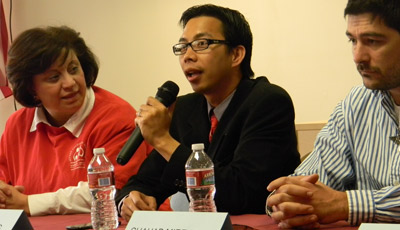
Paul Hoang, president of Viet-CARE, encourages others to support the program. Photo by Tam Nguyen
GARDEN GROVE, Calif. ― The stories of what can happen when patients cannot communicate with their doctors flowed at a community forum.
Like the story of Ba Tran, whose medical condition worsened because he and his specialists could not speak the same language. Relatives and friends tried to interpret and give Tran the information, but the correct information got lost in the translation.
Or the story told by Hien Nguyen, an expectant mother whose own mother was struggling to communicate with doctors in the hospital. With her mother hesitant to call her daughter and add stress to her pregnancy, it wasn’t until a Vietnamese doctor entered the older woman’s hospital room late at night that she learned she had suffered a mini-stroke.
To leaders of the Vietnamese community, such stories are tragic ― and unnecessary.
With the reforms coming as the Affordable Care Act is implemented, federal funding will be available to Medi-Cal to help pay for a medical-translation program ― if California applies for it. With millions of previously uninsured Californians becoming eligible for Medi-Cal under the act, a countless number of people for whom English is not their first language could benefit.
At the forum, held March 16, Viet-CARE, an advocacy for the health of Vietnamese Americans, encouraged people to sign its petition urging Gov. Jerry Brown to seek the funding.
Organizers hoped that with enough signatures, Gov. Brown would ask for funds for a medical-interpreting program. Organizers said officials in Sacramento do not recognize the number of Orange Countians who speak only one language fluently and have limited English capabilities. In all, 7 million Californians have language-access needs, according to the organization Interpreting for California.
“Sometimes I have troubling translating to my parents on what their specialists are saying,” said Tom Nguyen, a community member who attended the forum. “I hope this would change the minds of the governor and the legislature.”
Viet-CARE is working with Interpreting for California and other nonprofit groups on collecting signatures for the petition. The petition can be signed online at http://action.afscme.org/c/987/p/dia/action/public/?action_KEY=4794.
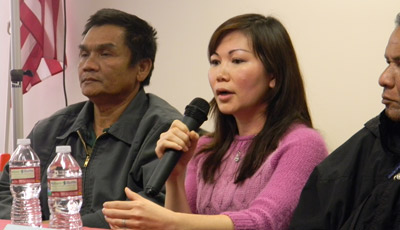
Hien Nguyen tells her story about her mom. Photo by Tam Nguyen
Another speaker at the forum, Julio Perez, shared his tragic story about the time he accompanied his mother on a visit to a clinic with his sick brother, 5.
“One day when my brother got sick we went to the clinic for help, but my mom did not understand English, so I had to interpret for my mom,” said Perez, a student at California State University, Fullerton. “I wasn’t clear on how to interpret the situation, and I was feeling a lot of pressure because my mom depended on me. Then we ended up going to St. Joseph Hospital [in Orange, Calif.] to get a better understanding, but there still wasn’t a Spanish nurse or doctor to talk to.
“After some time had passed going back and forth talking to people who would not understand the situation, my brother finally went into surgery but it was too late and he passed away,” Perez said, wiping away tears.
State Sen. Lou Correa (D-Santa Ana) also shared the story of how as a child in Anaheim he had to interpret English into Spanish for his family. He said he understands the plight of those who speak Vietnamese and other languages.
“I had to translate almost everything to my relatives when I was a young boy. I still do now when the people come to my office as a last resort to have a better understanding,” Correa said.
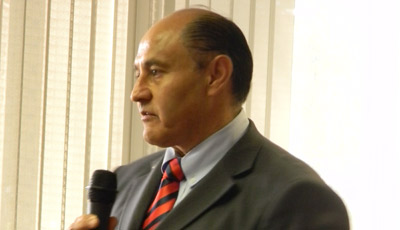
State Sen. Lou Correa shares his own experience. Photo by Tam Nguyen
“I promise to bring these stories and my own stories straight to Sacramento so we make this program possible,” Correa said.
Assembly member Sharon Quirk-Silva (D-Fullerton) recalled her days as a teacher when students needed to interpret what she said for their parents. She said she never knew if the students were truthfully or accurately translating her words.
“So I understand how the patients can be misinformed and it can lead to a bad road toward the end, such as Julio’s brother,” she said, adding she joins Correa in his commitment to encourage legislators in Sacramento to push for a medical-interpretation program.
Paul Hoang, president of Viet-CARE, said he is hopeful the program will become a reality.
“We are one step away to make this happen,” he said. “All we need to do now is let Governor Brown know that this program is in demand.”
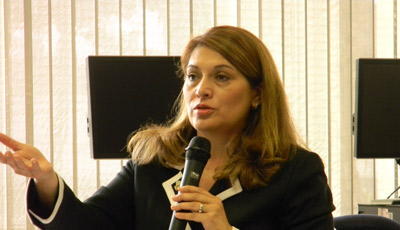
Assembly Woman Sharon Quirk-Silva addresses the community. Photo by Tam Nguyen