From WIRE REPORTS
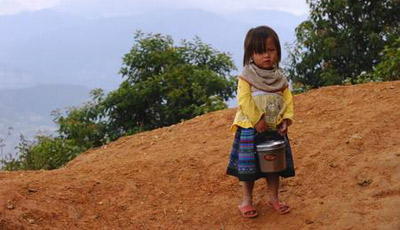
An ethnic H’mong hill tribe girl walks home after a school day at a village in the mountainous district of Mu Cang Chai, in the northwestern Vietnamese province of Yen Bai. Children from poor rural and remote regions typically suffer from stunting as a result of malnutrition. and it is more important to address this than increasing the average height of the Vietnamese people, critics of a government project say. WIRE PHOTO
More than most people, Dang Thanh Trang, who used to work as a trainer at a fitness center in Sai Gon for several years, knows well that children like her 13-year-old daughter need physical exercise for optimal growth.
“But I cannot arrange any time for it because of her school and study schedule,” she said.
The 40-year-old housewife is not very enthused about the announcement of a multimillion- dollar project that aims to improve the physical strength and stature of Vietnamese people. Trang says she cannot see her daughter benefiting from such lofty ambitions and is not really interested in them.
At a teleconference last week, the Ministry of Culture, Sports and Tourism revealed ambitious plans to increase the average height of Vietnamese men at 18 years to 5 feet 5 3/4 inches by 2020 and 5 feet 6 ½ inches meters by 2030. The target heights for women are 5 feet 1 ½ inches and 5 feet 2 inches, respectively.
The project, approved in 2011 and estimated to cost around $287 million, covers studies and action programs that will increase awareness and encourage exercise and other healthy habits.
Viet Nam’s gross domestic product was around $136 billion last year.
Figures released at a conference in Sai Gon in March said Vietnamese men and women have grown only 1 ½ inches in the past 35 years.
Experts then had blamed poor nutrition and lack of physical activity for Vietnamese people being shorter than many of their neighbors.
The new project will target pregnant women and children from birth until 18 years of age, ensuring nutrition supplies, physical activities and greater awareness of health and physique among the general public.
Doctors said at the teleconference that children need deep sleep and should go to bed before 10 p.m. and exercise at least 30 minutes a day.
A statement on the project website says a child’s height depends 31 percent on nutrition, 23 percent on genes, 20 percent on physical exercise, 16 percent on the environment and the rest on other factors.
However, experts say project planners have not taken into account sufficient scientific studies and that it is basically misdirected. The huge costs envisioned should instead be spent on improving living standards of the people, they add.
Nguyen Van Tuan, a Vietnamese senior researcher on bone genetics at the Garvan Institute of Medical Research in Australia, said relevant agencies should reconsider the project’s feasibility and possible effects on the residents.
“I think it is unnecessary to spend the money on research that has no sound scientific foundation and will not benefit the residents,” he said.
Tuan said it was wrong to say that the height of Vietnamese people has been developing at a low pace.
He said a survey by the Fels Research Institute in the United States found the average height of a group of people in Ohio increased at about the same rate as Vietnamese over the past several decades.
“Thus, the height of Vietnamese youths has actually increased rapidly.”
Tuan also said it is impossible to increase the average height of Vietnamese people by the target goal in less than 20 years by improving nutrition and physical exercises.
He said there is no study showing that genes account for just 23 percent of a person’s height as stated by the project.
“Hundreds of genetic studies over the past 50 years, including my own, show that human height depends 65 to 87 percent on genes,” he said.
Tuan said Viet Nam should prioritize improving living standards instead of focusing on increasing the height.
“I suggest the project’s investment be used to improve the public health-care system in rural areas,” he said.
Nemat Hajeebhoy, Viet Nam country director for Alive & Thrive, a Washington-based nonprofit organization that seeks to improve health and nutrition and reduce stunting, said it is critical that Ministry of Culture, Sports and Tourism works closely with Ministry of Health and the National Institute of Nutrition to ensure that “this money is invested wisely and is invested in evidence based interventions.”
She said the project should focus on the first 1,000 days of a child’s life ― from pregnancy (nine months) to the time the child is 2 years old.
“This means that the Ministry of Culture, Sports and Tourism must invest in…exclusive breastfeeding up to six months…and good quality complementary feeding, i.e. ensure that the quality of foods given to infants from the time they are 6 months old is nutritionally appropriate,” she said.
“This is the most critical window of opportunity if we want to impact height through nutrition interventions. If this critical window is ignored then we will not see the change that we want to see.”
Only 17 percent of mothers exclusively breastfeed in Viet Nam, the lowest rate in Southeast Asia.
Tran Thanh, another Sai Gon resident, is not dismissive of the project’s aims, but is very skeptical about its implementation.
She said a major part of the project of improving the nutrition intake of Vietnamese children will be difficult to carry out because of high milk prices.
“Most people think about milk when talking about nutrition. Doctors say it improves height. But mothers like us are really concerned about frequent milk price hikes,” she said. “For children of poorer family, milk is just a dream.
“There should be practical actions rather than just discussing the plan and propagandizing without any real impact.”