By Anthony Lappé, Huffington Post
American troops are amassed at the border of a Central Asian republic. The U.S. is on the brink of war — not with with Muslim extremists, but with the Soviet Union. It’s November 22, 2013.
John F. Kennedy
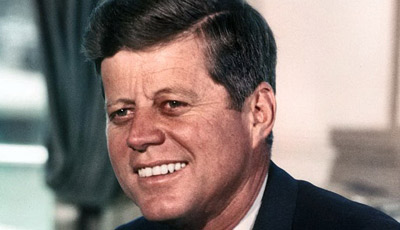
This week, we are all looking back at the terrible events that happened fifty years ago in Dallas. But what about looking back at what didn’t happen? What if JFK had survived that fateful day and went on to serve two terms as president? How might the 60s have been different, and how might it all have lead to a parallel universe present day in which the U.S. is about to go to war with a still-kicking Soviet Union? JFK WTF? you say. Well, it’s not as crazy as it sounds. Join me in the way-back machine for a thought experiment in JFK alternate history:
November 22, 1963
When President Kennedy arrives in Texas, he is three years into a tumultuous first term. He has weathered six international crises, including a bungled invasion of Cuba, the erection of the Berlin Wall and a standoff with the Soviets over missiles that brought the human race to the brink of oblivion. Republican opponents are calling him an appeaser, his approval numbers are stagnating, new international crises are looming and chronic health problems are making getting through the day a struggle.
As the motorcade makes its way through Dallas, adoring crowds line the route. The president’s limo rounds the corner in Dealey Plaza and shots ring out. The first bullet misses. The second slices through his neck. As he slumps down in his seat a third whizzes by his head, missing by inches. The president is gravely wounded. The First Lady desperately applies pressure to the wound as the limo speeds off. He is clinically dead for several minutes before dramatically being revived as live TV cameras report from outside the hospital.
The blood-soaked First Lady emerges as a hero. But there’s another reason why JFK survived that day. His closest advisors would later reveal if he had been wearing the brace he normally wore to aid with his ailing back, he wouldn’t have slumped down after being hit, and the third shot would have taken half his head off.*
A wave of shock and relief sweeps the nation. The American public rallies behind the president with bipartisan zeal.
Surviving the assassination has a powerful psychological effect on him. He begins speaking in stark terms about the need for world peace and a move away from violence as an instrument of foreign policy. Pressure from his hawkish advisors to send ground troops to Vietnam is ignored. He is still the Cold Warrior he ever was, in that he believes American values will triumph over communism, but he is now committed to finding a peaceful way to achieve those ends.
Commentators call it the “Martyr’s Mandate” as he pushes forward a new foreign policy agenda that calls for the launch of disarmament talks with the Soviets and an increase in official communication and cultural exchanges.
Psychologists would later note the president had been dodging death his whole life, from childhood health problems that forced him to spend two months in the Mayo Clinic to a World War II naval battle that nearly killed him. Now he feels as if he is on a spiritual mission to end the threat of global thermonuclear war.
But everything JFK would try to do would almost be derailed by a scandal that nearly destroys the Kennedy legacy.
A Different 60s
Without the Vietnam War, the landscape of America in the 1960s is radically different. There is no draft. No body bags coming back. No White House sending its young men to fight someone else’s war.
The battle over Civil Rights becomes the central domestic issue. When Kennedy is reelected by a landslide in 1964, he pledges to support the black cause. But behind the scenes, storm clouds are gathering. Kennedy doesn’t have the skills of his Vice President when it comes to pushing legislation through Congress. Aides warn he’s moving too fast — that the south will buck at being forced to integrate by an elitist Catholic chief executive.
FBI director J. Edgar Hoover increasingly views JFK’s near-religious adoration among the public, his embrace of civil rights and push for rapprochement with the Soviets as a nothing less than a threat to the republic. He expands his already extensive spying operation on the White House. He reaches out to southern racists and mob associates in secret meetings to plot against Kennedy and leaders such as MLK Jr. The FBI begins an aggressive program to infiltrate and disrupt the civil rights movement with the aid of organized crime, who offer their aid in an effort to weaken their mutual arch-enemy, Attorney General Robert F. Kennedy.
Hoover begins leaking wiretaps of MLK Jr. to the press, urging them to take him down. He even hints that he has damaging evidence on the Kennedy brothers. At first there are no takers. But the country is in flames. When a march on Jackson, Mississippi is met with extreme violence from local police and KKK members, riots engulf southern cities. There’s a tense stand off between U.S. army troops and local police. A constitutional crisis erupts. Our allies begin talking of boycotts of American goods, reminiscent of the global movement against Apartheid in South Africa.
Read the full article by Anthony Lappé from Huffington Post.