By Mark Santow, Huffington Post
A half-century has elapsed since that cold Dallas afternoon when President John F. Kennedy was murdered. Even now, these events continue to capture our imagination. Why? Surely some of it stems from the energy and charisma of the young president himself. Few things shock us more than seeing someone cut down in their prime, their great promise unfulfilled.
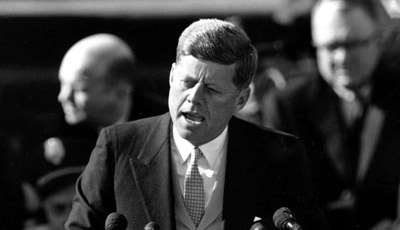
John F. Kennedy
Much like 9/11 for Americans of this century, Kennedy’s seemingly inexplicable murder inspired an almost existential sense of national and individual vulnerability. But it also seemed to mark a profound change in our national story. One rarely finds anyone who lived through the events of November 1963 that does not think that something profoundly changed in their wake.
The next five years did bring about a remarkable expansion of equality and freedom, including an end to racial apartheid in the South. The civil rights movement was in the saddle here, not the politicians in Washington. Kennedy does deserve praise for finally speaking out on civil rights on June 11th 1963, and submitting a civil rights bill to Congress. But Robert Caro’s recent biography of Lyndon Johnson makes it abundantly clear that Kennedy’s successor was ultimately better suited to help with this extraordinary change. Johnson orchestrated the passage of the bill in 1964, aided in part by the political tailwind of Kennedy’s murder. It is surely a cruel irony that JFK’s civil rights law may never have passed, without the extraordinary events of November 1963.
But those five years after Kennedy’s murder also included a brutal and unnecessary war, an exponential increase in government dishonesty, and a blunt and still unresolved confrontation with racial inequality in the urban North.
And then in 1968, the two public figures that seemed most capable of redeeming the national promise of peace and justice followed JFK to the grave in bloody fashion.
Many historians also believe that JFK’s death was a watershed moment, particularly with regard to Vietnam.
Exactly two years before that fateful day in Dallas, Kennedy signed National Security Action Memorandum 111 . In it, he authorized a significant increase in the American advisory effort in South Vietnam. He also stepped up aid to the embattled Diem regime, which was under increasing attack not only by Communist-led guerrillas, but also by a large percentage of the broader population.
This document would seem to support the arguments of those who credit Kennedy with starting the Vietnam War. But if we dig a little deeper, we begin to discern the hazy outlines of another path – one brutally cut short in Dallas.
Read the full article by Mark Santow from Huffington Post.