By Carl Thayer, The Diplomat
President Vladimir Putin paid a whirlwind one-day visit to Hanoi on November 12 to advance the comprehensive strategic partnership reached with Vietnam last year. This was Putin’s third visit to Vietnam and his second since assuming the office of President of the Russian Federation.
President Truong Tan Sang (left) and President Vladimir Putin
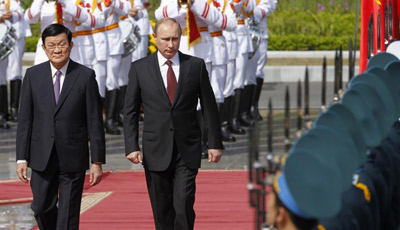
Putin met Vietnam’s top three leaders, Prime Minister Nguyen Tan Dung, President Truong Tan Sang and party Secretary General Nguyen Phu Trong. At the conclusion of his visit it was announced that seventeen bilateral agreements had been reached, including five in the oil, gas and energy sectors. These agreements were a reflection of the broad-based nature of bilateral relations developed ten years after the collapse of the Soviet Union.
Vietnam’s armed forces — air defense air force, navy, armor and artillery corps — are dependent on Soviet-era spare parts and equipment and badly in need of modernization. Between 1993 and 2000, Russia sold Vietnam twelve Su-27SK and Su-27UB Flanker jet aircraft, two missile attack corvettes, four radar systems, and other military equipment.
In March 2001, the Russian Federation became Vietnam’s first strategic partner. At that time the two sides mapped out eight major areas of cooperation: political-diplomatic, oil and gas, hydro power and nuclear energy, trade and investment, science and technology, education and training, culture and tourism, military equipment, and technology.
Article 8 of the agreement on strategic partnership specified that , “The two parties will strengthen their cooperation in military supplies to meet Vietnam’s and Russia’s security demands and not to oppose any third country.”
Between 2001 and 2008 bilateral relations were constrained by the poor state of the Russian economy; consequently the strategic partnership had very thin underpinnings. Since 2008 Russia regained political stability and its economy has been bolstered by the development of oil and gas reserves. Russia sought to exploit the market opportunities in fast growing Vietnam and the transport links between Vietnam and the Russian Far East.
Russian arms sales to Vietnam soon became a significant component of the strategic partnership.
Between 2008 and 2012, the Vietnam People’s Army Navy took delivery of two Gepard-class guided missile frigates and four Svetlyak-class fast patrol boats. The navy also procured 40 Yakhont/SS-N-26 and 400 Kh-35 Uran/SS-N-25 anti-ship missiles.
In 2009, Vietnam signed a contract for the purchase of six advanced Project 636 Varshavyanka (Kilo-class) conventional submarines.
Vietnam’s air defense air-force took delivery of twenty Su-30MK2V combat aircraft armed with Kh-59MK anti-ship cruise missiles, 100 R-73 (AA-11 Archer) short-range air-to-air missiles, 200 9M311/SA-19 Grison surface-to-air missiles, two batteries of S-300PMU-1 surface-to-air systems, four Kolchnya air defense search radars and three VERA passive radio locators. Vietnam also took delivery of two batteries of the K-300P Bastion coastal defense missiles.
On July 27, 2012, Presidents Putin and Sang met in the resort city of Sochi and adopted a Joint Statement raising their bilateral relations to a comprehensive strategic partnership. Russian arms sales and service contracts to Vietnam now became the most significant component of their bilateral relations.
Read the full story by Carl Thayer of the Diplomat.