By Richard Perez-Pena, New York Times
A disparate group of colleges from across the country — public and private, two-year and four-year — plans to announce a novel alliance on Friday aimed at producing high-achieving community college graduates and making it easier for them to transfer into bachelor’s programs.
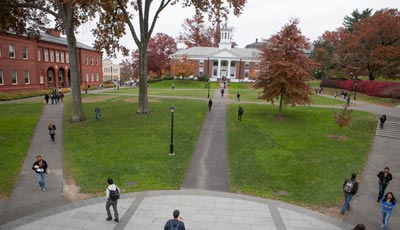
Amherst College has joined an alliance that seeks to make it easier for talented community college students to transfer into bachelor’s programs. Ilana Panich-Linsman for The New York Times
The coalition builds on a program called American Honors to create honors programs within community colleges, with competitive admissions, demanding academics and intensive guidance for highly talented students. That program, created by a for-profit company, Quad Learning, and a handful of community colleges, is less than two years old and still small — only about 230 students at five community college campuses — but plans call for it to grow rapidly, quadrupling the number of students by next fall.
The 27 four-year institutions in the alliance include several of the nation’s most prestigious and range from giants like Ohio State to smaller colleges like Amherst and Middlebury. Administrators say they have been impressed by students in the program, including the first group of 17 who graduated last spring and were accepted as transfers to universities including Vanderbilt, Stanford and Georgetown.
Educators and policy makers see community colleges as a crucial answer to the need for more college-educated workers and the rising cost of education because they have lower entry requirements and much lower prices than four-year universities. And with the number of college-age Americans falling after decades of growth, four-year colleges are looking for new sources of students.
“Community college transfers are going to be more and more a part of the college picture, because there’s big potential there,” said Kasey Urquidez, associate vice president for student affairs and enrollment management at the University of Arizona, which is joining the program. “From what we’ve seen, these American Honors students are going to be really good students who are well prepared and can persist and graduate.”
Read the full article by Richard Perez-Pena from New York Times.