By Cathryn Creno, The Republic
Personal technology such as iPads, notebook-size word processors and electronic pens that scan words and display definitions are helping Arizona special-education students keep up in class this year.
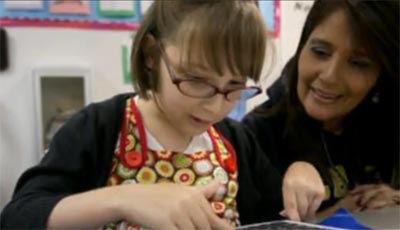
Assistive technology at Mesa Public Schools. Image taken from video by azcentral.com
The Arizona Department of Education has distributed a $265,000 federal grant among 12 school districts and charter schools that will study ways to better equip students with what educators term “assistive technology.”
Grace Ehmke, for instance, is on the honor roll at Mesa Public Schools’ Pomeroy Elementary thanks in part to a $200 word processor called a Forte.
The 11-year-old struggles to hold a pencil because she has cerebral palsy, a condition that hinders her fine motor skills. The Forte helps her keep up with her fast-paced sixth-grade class.
“I use it for writing assignments and things like social studies,” Grace said. “I’m a fast typist.”
Jan Cawthorne, Mesa Public Schools’ special-education director, said assistive technology is not new for her district or many others receiving the grant money. What is new is the portability of many devices — and a coolness factor that didn’t exist before the iPad, she said.
Since the advent of tablet computers, more special-education students and their parents are requesting devices from school districts, she said.
“Assistive technology used to mean big, clunky things that kids were embarrassed to be seen with,” Cawthorne said. “Now, it is a cool thing to use.”
“The Forte is really cool,” said Grace’s mother, Sarah Ehmke. “It gives her a lot of independence.”
Mary Keeney, assistive-technology specialist for the state Education Department, said the main mission of the grant program is to teach educators which devices can best help special-education students.
Federal law requires school officials to assess special-education students for technology needs, but it does not mandate they provide all students with devices, Keeney said.
“There is a real science to it,” she said. “First, you assess where the student’s barrier to learning is; then, you try the technology.”
Patricia Geraghty, Mesa Public Schools’ director of training and compliance, said parents of special-education students sometimes call the district to request iPads for their children. But, despite the popularity of tablet computers, they are not a panacea, she said.
Some kids with manual-dexterity problems have trouble swiping tablet computers and find that traditional keyboards or low-tech pencil grips and slant boards for writing work better, she said.
For other students, pens that scan words and display definitions can replace a computer with a vocabulary-software program, she said.
To help schools and districts with small technology budgets, the Education Department has an assistive-technology loan library on the campus of Northern Arizona University.
Last year, schools checked out more then 2,000 items, ranging from iPads to pencil grips. It allowed students and teachers to try the devices before the district purchased them.
The library is funded with part of the $780,000 Keeney’s department receives annually from the federal government.
Read the full story by Cathryn Creno of the Republic.