By Rebecca Hiscott, Mashable
Before MakerBot, no one could have conceived of Napster for fashion. A Burberry trench couldn’t be replicated digitally, which meant the garment industry was more or less safe from the revolution that upended music production and book publishing.
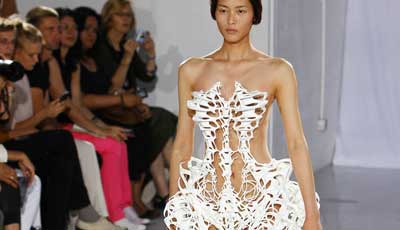
A model wears a creation by Iris Van Herpen for the Fall-Winter 2011-2012 Haute Couture fashion collection presented in Paris, Monday, July 4, 2011.
But with 3D printing, Fifth Avenue is headed for its own disruptive moment.
3D printers can manufacture spare parts for spacecraft, produce food and housing, even replicate human organs. Simultaneously, the materials used in 3D printers are improving by leaps and bounds, incorporating metals and plastics, wood and nylon. New York-based Shapeways has begun selling 3D-printed objects, including jewelry, while Continuum has created a 3D-printed bikini with plastic pieces that snap together. And an Atlanta entrepreneur is currently experimenting with a printer that can create garments out of polymer fabrics — the future of 3D-printed textiles.
“We are living a world in which fashion and design take on a personal element,” says Jonathan Askin, a professor with the Brooklyn Law School and a consultant in Internet law. “The same way anyone is now a publisher or a music distributor, now almost everyone can become a fashion creator.”
At the moment, 3D-printed fashion exists mainly in the world of haute couture. Iris Van Herpen’s skeleton dress (see below) and the angel wings that debuted at the 2013 Victoria’s Secret Fashion Show are artful, sure, but not particularly wearable. There’s still a long way to go before we’re all sporting 3D-printed blouses and yoga pants. In the world of tech, however, “a long way” can sometimes mean just a few years. If 3D-printed bracelets and rings are already well within consumers’ budgets, how far behind are sneakers and tank tops?
As 3D printing evolves, it will introduce new conflicts into the already murky arena of copyright law. The community built around 3D printing embraces open-source code and designs rather than tightly protected trade secrets. MakerBot’s Thingiverse is the pioneer in that space, offering all kinds of open-source, customizable and printable items, including jewelry.
“We’ll no longer have to buy a suit off the rack and hope it fits. We’ll no longer have to buy a dress with that particular belt or ribbon,” says Askin. “We can tailor everything to suit our own specific desires.”
Read the full article by Rebecca Hiscott from Mashable.