By Minxin Pei, Fortune
Many view the resource-rich South China Sea as a likely flashpoint in East Asia; one that could ignite both localized military conflicts and drag in the United States. And for good reason.
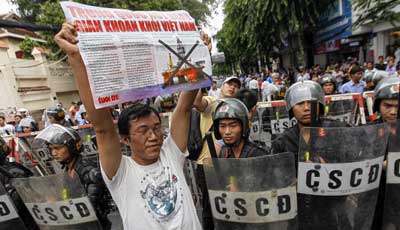
An anti-China protester stands in front of policemen blocking a street leading to the Chinese consulat during a rally in downtown Ho Chi Minh city on May 11, 2014. Protesters staged one of Vietnam’s largest ever anti-China demonstrations decrying Beijing’s deployment of a deep-water drilling rig in contested waters as territorial tensions soar. (Photo by LE QUANG NHAT/AFP/Getty Images)
The vast expanse of water contains abundant fisheries, immense untapped oil and natural gas deposits, and small uninhabited islands or rocks contested by China, Vietnam, the Philippines, Malaysia, and Brunei.
Things got ugly in early May, when dozens of Chinese official ships confronted Vietnamese coast guard patrol boats approaching a giant oil rig deployed by Chinese offshore oil company China National Offshore Oil Corp (CNOOC) in waters claimed by both China and Vietnam. In the ensuing melee, a Chinese ship rammed a Vietnamese ship, injuring several Vietnamese crew members. Another Chinese ship doused a Vietnamese ship with a water cannon.
No shot was fired during the incident. However, the confrontation foreshadows potentially more dangerous escalations to come, particularly between China and Vietnam.
Based on international law, Chinese claims in the southern parts of the South China Sea (the Spratlys) are much weaker because these parts are farther away from China. China effectively controls only five “features” of this region (unsubmerged small reefs), while Vietnam occupies close to 30.
However, Chinese claims in the northern parts of the South China Sea are stronger because of China’s effective control of the Paracels, a group of islands that fell into Chinese hands after its navy routed the then-South Vietnamese navy in a brief but decisive battle in 1974.
Despite its military defeat, Vietnam has never conceded the sovereignty of the Paracels while China firmly believes it rightfully owns them. As a result of these conflicting claims and the fact that the exclusive economic zones (EEZ) of China and Vietnam overlap each other in this area, neither country is willing to back down. The site of the latest maritime confrontation is 120 miles from Vietnamese coasts but sits within the 200-mile EEZ of the Chinese-occupied Paracels.
Until now, confrontations near the waters of the Paracels were limited to China’s harassment of seismic surveying activities conducted by Vietnam. While such incidents could lead to escalation, seismic surveying activities themselves do not create hard facts on the sea floor, limiting the potential for conflict.
Read the full aricle by Minxin Pei from Fortune.