By Vi-An Nguyen, Parade
America’s love affair with the donut has been deep and abiding. In his new book, The Donut: History, Recipes, and Lore from Boston to Berlin, food historian Michael Krondl chronicles how this tender, sweet pastry came to be—and came to be one of our collective favorite foods.
Donuts. (PARADE)
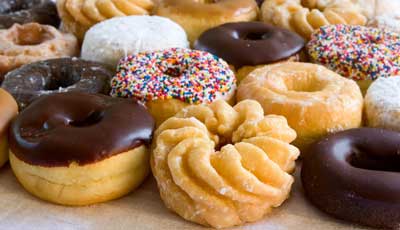
In honor of National Donut Day on June 6, we asked Krondl to share a baker’s dozen (13) little-known facts about the donut, below.
1. Who made the first donuts
The origins of New England’s original donuts likely lie with settlers from the English county of Hertfordshire, who brought with them recipes for yeast-raised “Hertfordshire Nuts,” which were also called “dow nuts” (dow-nuts is likely a non-standard spelling of dough-nuts). It’s a little unclear which name came first, Hertfordshire Nuts or Dow-Nuts. Though the Hertfordshire Nuts date to a 1750 cookbook and the Dow-Nuts to a manuscript dated around 1800, both terms could have been used simultaneously.
2. Where the “nut” in donuts came from
The original pastries, which didn’t have holes, were the size and shape of walnuts—thus the name.
3. How the holes came to be
When cake donuts became popular in the 1830s, cooks found they cooked more evenly if you poked out the middle. Some 80 years later, Maine sea captain Hanson Gregory took credit for the discovery, convincing more than one gullible landlubber of his sailor’s yarn.
4. How donut holes are really made
Though hand-cut donuts result in plenty of holes, modern machinery dispenses just the rings of dough, so the holes must be made separately. When Dunkin Donuts started selling their donut holes, they named them “Munchkins” after the Wizard of Oz characters, figuring the kids would go for the holes while the grownups went for the whole donuts.
5. The donut capital
When looking for a location for the first Krispy Kreme in 1937, founder Vernon Rudolph chose Winston-Salem, North Carolina, a city that had become famous because it was home to R.J. Reynolds, one of the world’s biggest cigarette companies.
6. Donuts for soldiers
During WWI, Salvation Army volunteers sought to boost soldiers’ morale with food. The “Sallies” started out with pies, but found that baking them on the road was impractical. Donuts could be fried on a camp stove, and were strongly associated with mom and home. After the war, the “Sallies” came home as heroines, popularized as such in movies and tin pan alley ballads such as “My Doughnut Girl.”
7. Donut-mobiles during WWII
Donuts kept their comforting reputation into the next world war, when the American Red Cross outfitted trucks with donut machines and gramophones. Young women volunteers drove the jalopies to the front lines where they made fresh donuts and spun the likes of Jimmy Dorsey and Duke Ellington for the war-weary GIs.
Read the full article by Vi-An Nguyen from Parade.