By Sam Borden, New York Times
SALVADOR, Brazil — It felt as if Tim Howard would never go down. As if the United States would never go down, standing there, taking shots like an undersized fighter clinging to a puncher’s chance. Howard saved with his hands, his feet, his legs, his chest.
Belgium’s midfielder Kevin De Bruyne (R) shoots to score the 1-0 during a Round of 16 football match between Belgium and USA at Fonte Nova Arena in Salvador during the 2014 FIFA World Cup on July 1, 2014. (PEDRO UGARTE/AFP/Getty Images)
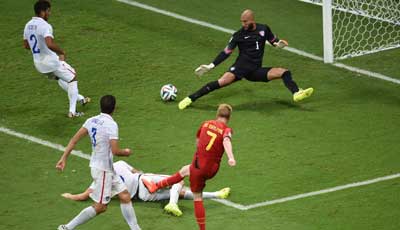
Trying to figure out where soccer fits into the fabric of America is a popular topic these days but, on Tuesday, sports fans across the country were inspired by the performance of a soccer goalkeeper. In a loss.
The ending was cruel, but then so is the game. The United States’ captivating run in the World Cup ended here, on the coast of Brazil, as Belgium beat the Americans, 2-1 after extra time, to eliminate the United States in the Round of 16. A win would have sent the Americans to a mouth-watering quarterfinal against Lionel Messi and Argentina on Saturday; this loss, instead, sent them home.
Of course, they did not go quietly. Buoyed by the incredible showing from Howard, whose 16 saves were the most by a goalkeeper in a World Cup game since 1966, the United States scraped into extra time tied at 0-0 and then responded after giving up two goals in the first of the two 15-minute extra periods. Julian Green, a substitute making his first World Cup appearance, scored to set up a frantic finish.
Ultimately, there was not enough from the Americans. Three draining group games in far-flung locations — including a trip to the Amazon — left the team gasping for air at the finish, and Romelu Lukaku’s goal in the 105th minute proved to be the difference.
At the final whistle, the fans here applauded, knowingly, surely mirroring the reactions of those watching on television back home. The ride had been incredible: Americans purchased more tickets to games here than fans from any country other than Brazil, and television ratings in the United States blasted through ceilings, surpassing those of the N.B.A. finals or the World Series. Watch parties, too, popped up in places far more varied than just craft breweries in Brooklyn, with fans gathering everywhere from Hermosa Beach in California to a library in Birmingham, Ala., to the Tulsa Drillers minor league baseball stadium in Oklahoma. A gathering at Grant Park in Chicago on Tuesday was moved to nearby Soldier Field to accommodate a crowd reported to exceed 25,000.
There are many explanations for why the World Cup, finally, caught fire in the United States this year. Some have pointed to Brazil’s time zone being favorable for American viewers (especially as compared to South Africa four years ago). Others say soccer’s spike is simply the result of increasing interest among Hispanics and Millenials — in other words, a steady rise in the number of soccer-loving children growing up to become consumer adults.
“These are all young people who grew up with the game, followed the sports, whether it be the English Premier League or Major League Soccer, and they don’t need to be convinced that soccer is a sport that is worthy of their attention,” said Don Garber, the commissioner of M.L.S. “The country has changed. This is a new America.”
Statistics seem to support that claim. Roughly 14 percent of people between the ages of 12 and 24 said professional soccer was their favorite sport, second only to the N.F.L., according to Rich Luker, who runs a sports research firm. That leads to savvier and more-informed fans who are more likely to continue following the sport even after the pageantry of the World Cup is over.
Read the full article by Sam Borden from New York Times.