By Tuan C. Nguyen, Washington Post
You’d be hard pressed to think of anything that better exemplifies the trend toward instant gratification than the phenomenon known as sprayable food. In recent years, offerings have expanded from marginal items such as whipped cream topping to a growing selection of more complete foods that include fruit mouse, pancake batter and even coffee. But it’s a potential new grocery-shelf product, developed by a pair of Harvard students, which may indeed take the cake.
Two Harvard students have made eating a fresh, hot dessert incredibly easy. (Courtesy John McCallum and Brooke Nowakowski)
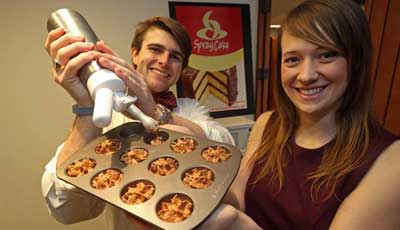
It’s called, well, Spray Cake and comes in the form of a premade batter that’s been neatly pressurized and packaged in a ready-to-use aerosol canister. Simply press the release mechanism and a rich, goopy mixture flows out from the nozzle to be shaped into a cupcake or whichever layout one has in mind. Toss the concoction in the microwave, and in about a minute you’ll have yourself a moist, freshly-made dessert.
Though it’s not exactly “cake in a can,” it may well be the quickest, most convenient way to do cake. Even powdered mixes, which help simplify the process, still require mixing in additional ingredients, such as eggs and vegetable oil as well as having some degree of patience for oven baking. With Spray Cake, “you can simply pull it off the shelf, make one cupcake, then put it back in the fridge and it won’t go bad,” Brooke Nowakowski told the Boston Globe.
The idea came about while Harvard student John McCallum was pondering various possibilities for a finals project for his cooking class. One of the recent lectures happened to be on the molecular interactions that cause cake to rise, which made him curious as to whether, instead of using baking powder, the same reaction can be carried out with propellant gases used in aerosol cans. After all, it’s the gas bubbles (carbon dioxide), released as baking soda or baking powder is heated, that gives cake its spongy texture.
With the help of Nowakowski, McCallum began testing the idea. His dorm roomed was turned into a kind of lab kitchen, where they experimented with combining aerosol technology with different recipes until they hit upon a formulation that produced batches that tasted the way a delicious cake should.
Read the full article by Tuan C. Nguyen from Washington Post.