By Jonathan Rigg, Straits Times
The case for South-east Asian exceptionalism has, in part at least, been laid at the door of “the family”. The South-east Asian family has been seen as a cornerstone in the region’s economic success.
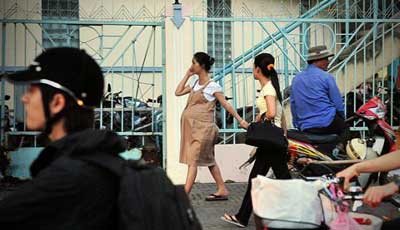
Migration can strain the family unit. In Vietnam, about half of female migrants to Hanoi and Ho Chi Minh City (above) are married, and over 80 per cent of those married when they first move have at least one child. — ST PHOTO: ALPHONSUS CHERN
And the family’s apparent resilience in the face of other social and economic transformations has become almost an article of faith. The family, it is believed, will not erode and decline as it is seen to have done in the Western world, and the family will not abandon its elderly and fail in the care of its young.
But South-east Asia now faces a perfect storm. It consists of falling fertility rates, an ageing population, growing levels of migration and mobility, the entry of women into the workforce, rising levels of education, and significant “ideational” change. Collectively, these changes have the potential to re-engineer social relations and norms.
Can the South-east Asian family ideal withstand such a demographic onslaught?
That this question might be answered in the negative is given credence by the number of terms that have been coined to describe the familial ructions evident across the region. Scholars and policymakers write – and worry – about “absentee” mothers (and fathers), and “absent” and “remote” parenting.
At root, these terms hone in on the same elemental question: How does the family care now, and will it – and how will it – care in the future?
There are two processes at work here. Fertility rates have declined across the South-east Asian region, in most countries to less than replacement levels.
At the same time, growing numbers of people have had to migrate to secure their livelihoods. The family is getting smaller, older and more dispersed.
These changes to the nature of the family raise a puzzle and provide the outlines of a key policy challenge. The puzzle is nicely captured by Linh, a Vietnamese female migrant in a 2008 study by Dr Catherine Locke, a specialist on Vietnam at the University of East Anglia in Britain.
Linh told Dr Locke: “If I want to provide for them (my children), I have to migrate. But when I migrate, I cannot take care of them.”
In Vietnam, around half of female migrants to Hanoi and Saigon are married, and over 80 per cent of those married when they first move have at least one child.
In Thailand, a 2012 survey by the National Statistical Office revealed that one-fifth or three million children were not living with either of their parents due to migration.
At the other end of the age spectrum, the proportion of the elderly living alone in Thailand doubled from 4 per cent in 1986 to 8 per cent in 2011, and the proportion living alone or only with their spouse increased from 11 per cent to 26 per cent.
Of all the social effects of migration, the most problematic are seen to be the effects of parental absence.
Read the full article by Jonathan Rigg from Straits Times.