By Nguyen Manh Hung, Cogit Asia
China’s placement of an oil rig inside Vietnam’s exclusive economic zone in May 2014 was a wake up call for the Vietnamese leadership. It took place at a time when Hanoi was filled with speculation about an intense struggle for power and secret dealings in preparation for the 2016 Communist Party Congress.
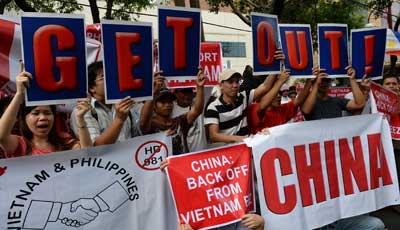
Vietnamese protesters hold placards as they shout slogans during an anti-China protest in front of the Chinese consulate in the financial district of Manila on May 16, 2014. Several hundred Filipino and Vietnamese protesters united in a march in the Philippine capital on May 16, demanding that China stop oil drilling in disputed South China Sea waters. (TED ALJIBE/AFP/Getty Images)
While Vietnamese dissidents hope transformational changes in leadership and policy will take place as a result of the oil rig crisis, party leaders continue to conduct “business as usual.” Nonetheless, the crisis has impacted Vietnamese politics in a variety of ways. First, it has made foreign policy, especially the issue of how to deal with Chinese encroachment, the focus of public debate, eclipsing domestic issues such as the dangers of rampant corruption and economic slowdown. Second, it has temporarily stiffened the will of Vietnamese leaders to stand up to Chinese provocations. Third, it has weakened the resistance of those who oppose closer relations with the United States.
For years Vietnamese leaders have been split into two groups: those who want to speed up reform and open up to the West versus those who are wary of the political implications of reform and want to rely on China to save socialism.
The oil rig crisis has narrowed the focus of disagreement between these reformers and conservatives. Rising nationalism and resentment against Chinese aggressive behavior have pushed the pressing issue of how to deal with Beijing to the fore. Vietnam’s leaders are now split between “liberationists” who are fed up with China’s constant pressure and want to find ways to escape its orbit, and “accommodationists” who hope to appeal to socialist solidarity and traditional friendship to cajole China into finding a compromise solution for the conflict.
China’s blatant aggression fans intense nationalistic feeling both within and outside the Communist Party of Vietnam. Public perception of the leadership’s weakness in dealing with China undermines the legitimacy and influence of accommodationists. A chorus of voices demands public disclosure of a 1990 commitment made at Chengdu, China in which Vietnamese leaders were alleged to have made secret concessions to Beijing.
Read the full article HERE.