By Pam Kragen, UT San Diego
CARLSBAD — Eight thousand miles west of Carlsbad, sturdy bridges are being built in impoverished Vietnamese villages, all in the name of love.
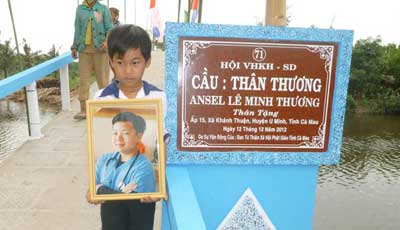
A Vietnamese boy holds a photo of Ansel Thuong Le at the entrance to one of the bridges built in Le’s name in Mekong Delta. — Hai Le
A few months after 15-year-old Ansel Thuong Le of Carlsbad passed away in 2012, his parents launched the bridge-building foundation to honor his name (Thuong means “to love” in Vietnamese) and to help them make some sense of his death.
So far, the family-funded Ansel Foundation Project has built three bridges, but there’s a need for at least 1,000 more, so Ansel’s parents, Hai and Loann Le, plan to continue building the monuments in his honor for the rest of their lives.
“Ansel had a very good plan for his future. When he left us so suddenly, we didn’t know what to do. We were paralyzed. That’s when a friend told us to do something positive in his memory to help us find a way through our grief,” said Dr. Hai Le, 53, an internal medicine doctor at Scripps Coastal Medical Center in Vista.
photo
A Vietnamese boy holds a photo of Ansel Thuong Le at the entrance to one of the bridges built in Le’s name in Mekong Delta. — Hai Le
To his parents — who met in the late 1970s in Long Beach, where their families immigrated after the Vietnam War — Ansel was a quiet, studious and serious student. He dreamed of a career in medicine and excelled in speech and debate as a sophomore at Carlsbad High School. But after Ansel died in an accident at the family’s home in October 2012, Le said he and his wife were surprised to discover another side of their son.
“More than 400 students came to the wake, and at the funeral, the entire speech and debate team told stories about how he helped other students, how he had strong opinions on social issues, what a tough debater he was, and how he often gave up his lunch hour to tutor others,” Le said.
In an essay written just a month before he died, Ansel explained his desire to follow his father and mother (a dietitian and health coach) into medicine, which he described as “a life spent toward alleviating pain, to allow people to thrive with the beauties of life, not trapped by its sorrows and sufferings.”
Ansel was so invested in the idea of becoming a doctor, he had his own stethoscope, medical chart and set of scrubs that he liked to wear when he studied. Because his parents knew the items were precious to the teen, he was buried with them.
Ansel was following a path first forged by his father, who as a boy dreamed of following in his mother’s footsteps. She was the only nurse in their suburban Saigon community.
“She was so powerfully useful. We were the only family with a first-aid kid and I wanted to be like her — to have that power to be useful and helpful to others,” Hai Le said.
After the fall of Saigon in 1975, Le’s father and eldest brother were sent to re-education camps by the North Vietnamese and a few older siblings immigrated to the U.S. to go to college. In March 1979, he and five of his siblings were able to travel with forged Chinese visas to an overcrowded island refugee camp in Malaysia. There, physicians from Doctors Without Borders would arrive by boat each week and work tirelessly with the cholera-stricken refugees.
Read the full story HERE.