By Andrew Lam, Huffington Post
At an ultra-chic bar called Nam Kha, a well-dressed woman in her mid-twenties named Tram tells me that she’s “si-tret.” She speaks Vietnamese but switches to English for a word heard often here. There is no equivalent word in her language. The closest you can get is cang thang than kinh–tension of the mind.
Vietnamese man using cell phone while on motorcycle. (Huffington Post)
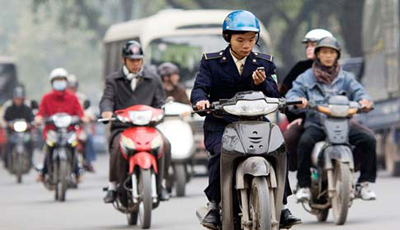
Stress is probably the biggest trend to hit Vietnam from America since MTV. At first glance it seems impossible: Vietnam, after all, is a country full of hardworking young people, and rural life is backbreaking for the majority. Generation after generation has known nothing but sweat and toil. But stress is a phenomenon not of simple hard work. It is a kind of symptom associated with young, upwardly mobile urban professionals in peacetime.
One is “si-tret,” therefore, like Huy Phan, thirty-two, an ad executive for Tien Phong publishing company, an association of lifestyle magazines. This evening at the Nam Kha bar he has lost his voice after talking nonstop for four hours with clients, models, and photographers on his expensive cell phone. “It’s always like this,” Huy complains. “It’s my day off, but I never stop working. I’m terribly si-tret.”
Vietnam’s upwardly mobile urban young are given to multitasking these days. Next to Huy, Tram is talking on one phone, ordering a drink, conversing with another friend, and, yes, text messaging on another cell phone–all at once. “I have a headache almost every night,” Tram complains. “I never had this kind of headache until I got my new job.” Her new job: overseeing dozens of young saleswomen in a cosmetic company.
Huy and Tram are quick to acknowledge that they are a privileged group with opportunities unavailable to previous generations in communist Vietnam. Just a generation ago more or less everyone had to stand in line to buy rice, and moving from city to city was a prohibitively complex task that required navigating Vietnam’s heavy bureaucracy. These days, young twenty- and thirty-somethings like Huy vacation regularly in Thailand and Singapore. Huy has traveled twice to the United States. Tram flies to Thailand every few months to “de-si-tret” herself. How? “I go shopping,” she laughs.
The owner of Nam Kha, on the other hand, says he’s not si-tret. Duc Phan, thirty-two, one of three partners who own a growing conglomerate of silk stores, restaurants, and resorts in Vietnam, is gentle and calm. He tells me his secret. “I have very good managers,” he says, smiling and patting the shoulder of a handsome young man standing next to him. “They si-tret on my behalf.”
Vietnam is a heated economy, in Asia second only to China in terms of growth. Tourism, too, is increasing. Bob Bannerman, who works for the U.S. consulate in Saigon, says that he sees a shift toward more economic and political transparency here in the last few years. “More and more foreigners are coming in to invest,” says Bannerman. “Vietnam wants to be taken seriously now, and there are many smart young people doing amazing things here.”
Read the full article HERE.