By ELIZABETH WEIL, New York Times
A hundred years ago, when Robert Falcon Scott set out for Antarctica on his Terra Nova expedition, his two primary goals were scientific discovery and reaching the geographic South Pole. Arguably, though, Scott was really chasing what contemporary observers call a sufferfest. He set himself up for trouble: Scott brought Manchurian and Siberian ponies that quickly fell through the snow and ice; he planned, in part, for his crew to “man-haul,” meaning that the men would pull sleds full of gear, instead of relying on dogs. Even when Scott’s men faltered, they continued collecting specimens, including rocks. The expedition ended terribly; everybody who made the push to the pole died. Miserable, starving and frostbitten, one of Scott’s last four men killed himself by walking into a blizzard without even bothering to put on his boots.
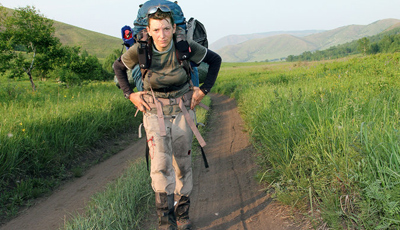
A self-portrait that Sarah Marquis took (her camera was on a cart filled with gear) north of Mongolia, during the first month of her trek across Asia and Australia. Credit Sarah Marquis
In the taxonomy of travelers, the word “explorer” suggests a morally superior pioneer, a man or woman who braves the battle against nature to discover new terrain, expanding our species’ understanding of the world. “Adventurer,” by contrast, implies a self-indulgent adrenaline junkie, who scares loved ones by courting puerile risk. The former, obviously, is the far better title, but it’s tough to claim these days. The world is Google-mapped. Reaching the actual virgin territory of space or the deep ocean requires resources that few possess. In short, the noble fig leaf of terra incognita has fallen away and laid bare the peripatetic, outsize bravado of Scott’s kindred spirits. The resulting itineraries are pretty strange. We now have guys like Felix Baumgartner sky-diving from a balloon-borne capsule at 128,100 feet.
Baumgartner falls squarely — and for more than four minutes, breaking the speed of sound — into the adventurer camp. But then there’s Sarah Marquis, who perhaps should be seen as an explorer like Scott, born in the wrong age. She is 42 and Swiss, and has spent three of the past four years walking about 10,000 miles by herself, from Siberia through the Gobi Desert, China, Laos and Thailand, then taking a cargo boat to Brisbane, Australia, and walking across that continent. Along the way, like Scott, she has starved, she has frozen, she has (wo)man-hauled. She has pushed herself at great physical cost to places she wanted to love but ended up feeling, as Scott wrote of the South Pole in his journal: “Great God! This is an awful place.” Despite planning a ludicrous trip, and dying on it, Scott became beloved and, somewhat improbably, hugely respected. Marquis, meanwhile, can be confounding. “You tell people what you’re doing, and they say, ‘You’re crazy,’ ” Marquis told me. “It’s never: ‘Cool project, Sarah! Go for it.’ ” Perhaps this is because the territory Marquis explores is really internal — the nature of fear, the limits of stamina and self-reliance and the meaning of traveling in nature as a female human animal, alone.
Meeting Marquis is strange if you’ve only seen her trip photos. In those, she is filthy, her hair is a rat’s nest and her eyes are introspective, beseeching and very alert. In person, she’s beautiful and charming; she always has a smile for waiters and cabdrivers, and her bangs are so well cut that they make her seem French. (Marquis’s hairdresser squashed her idea of shaving her head for her recent trek, saying, “After all the work we’ve done?!”)
Marquis grew up in Montsevelier, a village of 500 people in the Jura Mountains, in what Marquis describes as “the northern part of Switzerland — it’s not the nice part.” Her father, who worked as an engineer, paid Marquis one franc for every 100 slugs she picked out of the family garden. She befriended the family ewe, Moumou, and trained the pet rabbit to come when called. She liked people less. “My mom had nine sisters, and my dad had eight sisters and brothers, and those aunts and uncles all had three or four kids, so it was a big, screaming family, and for me it was a nightmare,” Marquis told me when I met her last winter in Washington. At age 8 she ran into the woods with her dog and spent the night in a cave. Marquis’s mother called the police, but when Marquis returned, her mother didn’t scold. Fighting Marquis’s wanderlust was hopeless.
When she was 16, Marquis answered a classified ad for a train company that promised free travel. She loved the idea of seeing Paris and Milan, but once Marquis started work, her colleagues, almost all of whom were older men, harassed her relentlessly. On the first day one man claimed he could smell that Marquis had her period. The experience was a boot camp — punishing but character-strengthening. “I learned how to build myself,” she said. “I built the tough skin I needed for later on. I learned how men worked.”
Marquis’s desire to travel began to coalesce around the question of whether she could survive by herself in nature. First, she decided to ride a horse across Turkey. On that trip, she ate apricots off trees and slept with her head on her saddle. Muslim women bathed her in warm goat’s milk. But after that, Marquis’s itineraries veered away from romance and pleasure into solitude and suffering. In her early 20s she flew to New Zealand and set out on a four-day backpacking trip with some noodles, a huge radio and three or four books — “everything except what I needed.” The outing, by typical standards, was a fiasco. Day 1 it poured; Marquis didn’t know how to set up her tent, and she was freezing and bored because, she now said wryly, “at night there was nothing to do.” But near the end of the trip she had a sort-of epiphany. “Something happened,” she said. (Articulating her reasons for pursuing her travels is not one of Marquis’s strengths.) “Over the years I’ve had this feeling again and again.” Chasing that inexplicable sensation is why she walks.
Marquis spent the winter after that trip earning money by bartending in Verbier, a fancy off-piste ski resort in the Alps. The next summer she returned to New Zealand. This time she walked into the South Island’s Kahurangi National Park without food to see if she could survive for 30 days. That trip, too, was a trial. Marquis failed at spearfishing, consumed only mussels and lost 20 pounds. But she not only recaptured that inchoate feeling she craved; she also glimpsed the savageness of her desire. “That was the first time I actually got in touch with the wild,” Marquis said. “You know when you’re really, really hungry? You have to teach yourself that food is not a big issue. You just need sleep and sweet water.”
Marquis returned to Switzerland and embraced the cycle — work for money, then leave on some extreme challenge she devised for herself. She canoed through Canada’s Algonquin park without knowing how to portage; she was attacked by beavers camping near water in Patagonia; she hiked the 2,650-mile Pacific Crest Trail. She remained captivated by what she describes as “this wild call from inside me” and decided to walk 8,700 miles around Australia.
For that trip, Marquis lined up her first sponsor, the North Face. She doesn’t think she impressed the company by her pitch. She believes it gave her a few backpacks, a couple of tents and some clothes because, she said, “when I told them what I was going to do, they thought, We can’t let that little thing go out without gear.” To supplement the inadequate supply of noodles she could carry, Marquis brought a slingshot, a blow gun, some wire to make snares and a net for catching insects. In the warm months, Marquis ate goannas, geckos and bearded dragons. In the cold months, when the reptiles hid, she subsisted on an Aboriginal standby, witchetty grubs — white, caterpillar-size moth larvae that live in the roots of Mulga trees. (Raw, Marquis said, they taste like unsweetened condensed milk; seared in hot sand, they crisp up nicely.) Throughout, Marquis tried to minimize human contact. She hid her femininity with loose clothes, big sunglasses, hair piled up in a hat. When water was scarce, she collected condensation, either by digging a deep hole and lining the cool bottom with plastic or by tying a tarp around a bush. If those techniques didn’t yield enough liquid — and they rarely did — she drank snake blood. At night Marquis slept close to the trunks of trees, touching the bark in a way that she describes as “almost carnal.” She fell in love with a particular twisted and wind-bent Western myall tree on Australia’s Nullarbor Plain.
On June 20, 2010, Marquis’s 38th birthday, she set out to walk from Siberia through Asia and, once back in Australia, trek to her beloved tree. The video of Marquis walking away from her starting point in Irkutsk feels like the setup for a horror film. “Hello, O.K., so here we are,” she said just before turning away from the camera. “Time to go now!” On her back is a 75-pound pack, and trailing behind her, overflowing with gear secured by bungee cords, is a custom-made cart that looks like a cross between a wheelbarrow and a giant roller bag — her dry-land sled. After Australia, Marquis couldn’t handle slaughtering more animals; she says it felt “like killing a friend.” So she decided to carry rice and hard biscuits (the latter inedible without “a nice, hot cup of tea”), which meant she would need to pull a cart. It now weighed 120 pounds.
To prepare for the expedition, Marquis spent two years walking or snowshoeing 20 miles a day, wearing 75 pounds. On the trip itself, she carried, among other things, five pairs of underwear, a large pocketknife, wide-spectrum antibiotics, tea-tree oil for massaging her feet, a solar-powered charger, a beacon, a BlackBerry, a satellite phone, Crocs, a compass, a tiny emergency stash of amphetamines (“that’s the backup backup backup of the backup; in case you lose a foot and you need to get out and not feel a thing”) and pink merino-wool pajamas (“you put them on and you feel good, you feel gorgeous”).
Read the full article HERE.