By Thai Nguyen, Huffington Post
It’s amazing how tuned out we become to the motor of the air-conditioner and refrigerator — the sudden silence is a startling reprieve. Likewise, we become numb to the buzz of our technology saturated world.
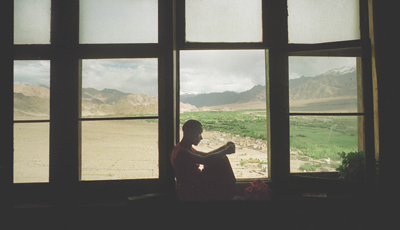
A Tibetan monk sits on the window inside the Thiksey monastery. (Photo by Paula Bronstein/Getty Images)
Smartphone users check their device every 6.5 minutes, which works out to around 150 times a day. Silence is replaced with a cacophony of communication, and solitude is replaced with social media.
Indeed they’re an endangered species: silence and solitude; yet great revelations and benefits are found in them. Here are ten:
1. Bypassing Burnout
Too often, our culture assigns self-worth with productivity. Whether it’s asking what your country can do for you, or what you can do for your country, the question remains — what can be done? It’s a one-way ticket to burnout.
Solitude allows for a break from the tyrant of productivity. And rather than being in opposition, doing nothing helps with doing much. Promega is a company with on-the-job “third spaces” where employees are able to take solitude breaks and meditate in natural light. The health benefits have resulted in improved productivity levels for the company. And will do the same for us.
2. Heightened Sensitivity
For many, attempting ten days of silence would be akin to walking on water. Vipassana silent retreats are exactly that; participants are instructed to refrain from reading, writing, or eye contact.
One hundred scientists went on a retreat for research and noted that shutting off the faculty of speech heightens awareness in other areas. Beginning with breathing, that focus and sensitivity is then transferred to sights, sounds, sensations, thoughts, intentions, and emotions.
3. Dissolving Tomorrow’s Troubles
Alan Watts argues that our frustration and anxiety is rooted in being disconnected — living in the future, which is but an illusion.
Silence brings our awareness back to the present — where concrete happiness is experienced. Watts makes the distinction between our basic and ingenious consciousness; the latter makes predictions based on our memories, which seem so real to the mind that we’re caught in a hypothetical abstraction. It plans out our lives with an abstract happiness, but an abstract happiness is a very real disappointment.
The future falls short of what the present can deliver. Silence and solitude pulls us out and immerses us back in the present.
4. Improves Memory
Combining solitude with a walk in nature causes brain growth in the hippocampus region, resulting in better memory.
Evolutionists explain that being in nature sparks our spatial memory as it did when our ancestors went hunting — remembering where the food and predators were was essential for survival. Taking a walk alone gives the brain uninterrupted focus and helps with memory consolidation.
5. Strengthens Intention and Action
Psychologist Kelly McGonigal says during silence, the mind is best able to cultivate a form of mindful intention that later motivates us to take action.
Intentional silence puts us in a state of mental reflection and disengages our intellectual mind. At that point McGonigal says to ask yourself three questions:
—–“If anything were possible, what would I welcome or create in my life?”
—–“When I’m feeling most courageous and inspired, what do I want to offer the world?”
—–“When I’m honest about how I suffer, what do I want to make peace with?”
Removing that critical mind allows the imagination and positive emotions to build a subconscious intention and add fuel to our goals. McGonigal explains, “When you approach the practice of figuring this stuff out in that way, you start to get images and memories and ideas that are different than if you tried to answer those questions intellectually.”
Read the full article HERE.