From Fusion
I want to show you something. First, below, you’ll see real seventh grade math homework, which I acquired from my father, who works at my old middle school. You probably recognize this sort of sheet from before “math” became algebra, geometry, and the calculus.
Math homework (Fusion)

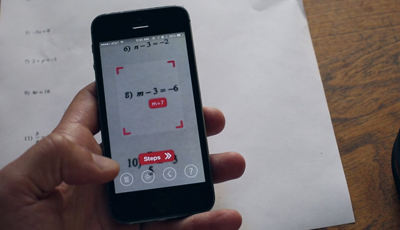
And then, the video below shows PhotoMath, a new app by the startup MicroBlink. Point a phone’s camera at an equation and it solves for a variable, sparkles twinkling around the letters and numbers. Since its debut a couple weeks ago, PhotoMath has become one of the most popular free applications in Apple’s App Store. It’s not the first software that can do basic algebra (that would be 1967’s MATHLAB). Nor is it the first app that can recognize letters and numbers that you show to it: those have been around for years. But it’s the seamless way PhotoMath combined character recognition and math skill that captured people’s imaginations. More than two million people have watched the video demoing its capabilities.
Could it be that math homework, as we once knew it, is obsolete? I tried the software out on this 7th-grade assignment, and I got answers to all 14 problems in under a minute using the app.
App that solves math problems. (Fusion)
This seems like a technological miracle! On the list of robots children of the 1950s might have asked for, an awesome free math-homework robot would have been up there with a bed-maker.
So, what could such an app actually do to/in math education? I got in touch with Nam Nguyen, who teaches math at my alma mater, View Ridge Middle School in Ridgefield, Washington. A very tech engaged teacher, Nguyen was familiar with the app and had invited his students to play with it. (They were annoyed it couldn’t solve absolute value functions.)
Nguyen isn’t worried about the app’s impact on his classes. The ways he wants his students thinking can’t be solved by software. “My teaching has shifted more to asking questions like, ‘What do you think? What is the first question you have? What do you know right now? Take a guess? What information do we need? How can we get that information?” he said.
The switch towards more open-ended problem solving and less grinding away on problems does seem to be where the leading edge of math education is. Even the controversial Common Core curriculum tests, as they might be implemented in New York, for example, would be immune to PhotoMath because none of the questions for seventh graders are simple equations.
So there is a megahappy scenario here: the robots take on all the busy work, and the students end up doing more substantive thinking.
Dan Meyer, a former math teacher and Stanford PhD student in math education, summarized this hope in a recent blog post about PhotoMath. “It’s conceivable PhotoMath could be great for problems with verbs like ‘compute,’ ‘solve,’ and ‘evaluate.’ In some alternate universe where technology didn’t disappoint and PhotoMath worked perfectly, all the most fun verbs would then be left behind: ‘justify,’ ‘argue,’ ‘model,’ ‘generalize,’ ‘estimate,’ ‘construct,’ etc,” Meyer wrote. “In that alternate universe, we could quickly evaluate the value of our assignments: ‘Could PhotoMath solve this? Then why are we wasting our time?’”
In other words, we should root for both a perfect robot equation solver and hope that it catalyzes innovation in math education. But, as Meyer hints, the technology does disappoint. The ways the app doesn’t work paint a miniature portrait of what will be so confounding about a world laced with artificial intelligence produced by today’s tech industry.
Read the full article HERE.