From FT
China’s new charm offensive in Asia – using infrastructure development to garner soft power at the expense of rivals US and Japan – has reached new heights in recent weeks. Multi-billion US dollar deals with strategic partners such as Sri Lanka and Pakistan aside, even countries with reservations about China’s rise have begun taking a more pragmatic view toward using China’s huge foreign exchange reserves to their benefit.
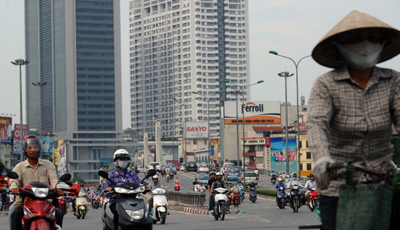
Vietnam (FT)
Earlier this month, Indonesian leaders travelled to Beijing seeking to tap financing for power and transport projects, notwithstanding the new administration’s strong emphasis on both national and maritime security. Chinese companies are challenging Japanese bids for high speed rail contracts in Malaysia and Thailand. This week, a team from Indian Railways flew to Beijing to discuss a potential Delhi-Chennai high speed rail link.
Yet in spite of the huge stashes of money available in Beijing, Chinese financing for existing energy projects in Vietnam – an economy with high dependency on China – has been all but frozen as a result of bilateral tensions over the South China Sea, according to research by Asean Confidential, a research service at the Financial Times.
Power grip
Outwardly, tensions have been temporarily patched up. Government officials on both sides have agreed to paper over mutual differences. Official bilateral trade has grown 15 per cent year on year, and in late September a new Asia Development Bank-funded expressway connecting Hanoi, Vietnam’s capital, with the Chinese border at Lao Cai was formerly inaugurated.
But since May’s anti-China riots, Chinese lenders have effectively frozen credit lines to many Vietnamese engineering, procurement and construction (EPC) contracts, leaving a number of projects in limbo and having forced some into restructuring. Unless this changes, Vietnam will have to rely heavily on South Korean and Japanese financing and subcontracting to fill the void.
What remains unclear, however, is whether South Korea and Japan are either willing or able to finance a planned 55 GW build-out between 2014 and 2030, with 29.5 GW of coal-fired generation targeted by 2020 alone (see map). The exposure of both countries to Vietnam is already high, potentially making them wary of further ratcheting up involvement.
Many of these projects are already into their first phase of development, and are heavily invested by Japanese and Korean companies – which account for roughly 60 per cent of cumulative foreign direct investment (FDI) stock, with companies such as Marubeni, Sojitz, Kepco, Daelim, and Hyundai Heavy Industries taking the lead backed by Japanese official development assistance.
The problem, however, is that the EPC contracts for many of these projects have been sub-contracted to state-owned Chinese consortiums, with sometimes up to 95 per cent of the total EPC value going to Chinese firms. These sub-contractors are in turn financed by export credits and concessional loans from Chinese policy lenders such as the China Ex-Im Bank – thus creating the vulnerability to a freeze in Chinese finance.
How far can diversification go?
In the meantime Vietnam is seeking to rapidly diversify both its investment partners and its energy mix. Recently concluded or announced power deals include participation by not only Japanese and Korean companies, but also those from Thailand, Malaysia, India and Russia.
Read the full article HERE.