By PAIGE TUTT, Bustle
A few months ago, I found myself watching a Barbie movie with my little cousins. Madison and Adrienne stared on in amazement as Barbie trounced the competition in a surf contest. As usual, the characters of color in the film were in the periphery. Barbie won that surf contest hands down, and the only person who came close to beating her was another white character. As I watched my cousins clutch their white Barbie dolls in reverie, I realized that what I was witnessing was nothing new. After all, in all the Barbie films I watched as a little girl, you never saw someone of color succeeding in the same way that you see Barbie and her white friends succeeding.
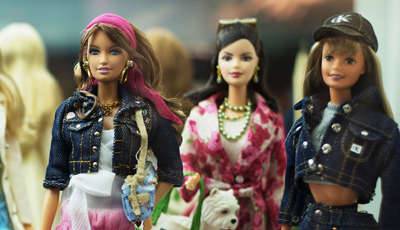
Barbie Dolls are displayed in the Barbie Experience during Sao Paulo Fashion Week Winter 2015 at Porao das Artes on November 3, 2014 in Sao Paulo, Brazil. (Photo by Studio Fernanda Calfat/Getty Images)
Seeing that movie brought back a lot of memories I had about Barbie from when I was Madison and Adrienne’s age. I watched the films where Barbie was a princess, a detective, or whatever she happened to be that time, and I didn’t recognize a path I could follow. Barbie didn’t look like me. I didn’t see any of the black Barbies winning the contest, solving the crimes, or saving the day.
My mother found the race war amongst my dolls extremely troublesome. Not long after, we drove over an hour from our quiet, all-white town in New Hampshire — just to find a black Barbie.
I recognized myself as inherently different and other compared to this beautiful, tall, blond doll. I would look at my kinky hair in the mirror, rub my ashy elbows, pull at my mocha-colored cheeks, and wonder why I didn’t look like my Barbie doll.
I wondered what other women of color’s experiences were like growing up with Barbie as a role model, so I asked seven of them how Barbie affected their growth and perception of identity as children. Here’s what they had to say.
AKIRAH ROBINSON
Barbie and I had a conflicted relationship when I was a child. I only owned two Barbies as a kid, and both were black. I liked them enough, but what I really wanted was a white Barbie. We all know why I thought white Barbies were prettier. In an effort to instill black pride into me, my parents would not buy me a white Barbie, which only made me want one even more.
I guess my folks felt I had enough white influences in my life, which makes sense. I grew up in a predominantly white area and had little-to-no black friends. When I realized my parents weren’t going to budge, I gave up and asked for a Kenya doll instead. I loved my Kenya doll and have fond memories of her. (Apparently, she’s still around, which makes me very happy.) After getting my Kenya doll, I hardly even remember caring about Barbie.
How do I feel about Barbie today? We still have a conflicted relationship, I think. If I were to have a daughter, I’d much rather she play with Legos or crayons than dolls — especially Barbie. Barbie just seems so unrealistic to me — her body, her pep, all the pink accessories. Also, I’m not a huge fan of gendered toys. I realize, however, that many kids like to play with dolls. So if my husband and I ever have a child who wants a Barbie, I think what’s most important to me is that he/she has dolls of all colors to play with. My husband is a white man (my parents absolutely adore him, by the way), so I have no interest in banning white dolls. I think I’d just want to encourage my kid to choose Barbies with interesting, intelligent hobbies and careers.
CHERISE LUTER
My understanding of black otherness expressed itself through my Barbies. I had multiple dolls, half of which were white and all of which were female, and I played with all equally, for the most part. But when I played date night with my multicultural collection, I used the colored dolls as the male counterparts to my white Barbies. My mother noticed my activity one day and, with wide-eyed innocence, I told her I used the colored dolls as the men because the white dolls were prettier. My parents were horrified and immediately bought every black-people-are-awesome book and film they could get their hands on to cure the sickness they thought ailed me.
I don’t believe Barbie was to blame for my mindset, but my Barbie play was a manifestation of the lessons I was learning about beauty. What my parents were seeing firsthand were the effects of the white is right, white is beautiful view I was inundated with on a daily basis — and it frightened them. Their emotional reaction frightened me as well.
So even though I have great memories of Barbie and her pals, those thoughts are sullied with memories of my first outward expression of internalized colorism.
MARIE SOUTHARD OSPINA
I won’t lie: Barbie was a pretty good friend for approximately eight years of my life (way longer than she should have been, perhaps. But I didn’t have many human friends, so… you know). From the ages of four to 12, I made it my sole mission in life to acquire as many disproportionate-but-fascinating plastic dolls as possible. More often than not, they had blonde hair, blue eyes, and eerily long legs. Whether she was a doctor, an astronaut, or a ballet dancer, I loved her fiercely and with undying commitment. But around the time I was eight, I began to realize she might not really love me back. (And not just because she was an inanimate object.)
I identify as a Latina, despite being mixed race. Aesthetically, I take after my father’s Nordic ancestry in height, complexion, and bone structure. But I have my mother’s Colombian curves — from the 50-inch derriere, to the D-cup breasts, to my 12-inch waist-to-hip ratio. So you see, around the time I became concerned with my appearance (age eight, which is around the time I think most chubby kids start feeling bad about themselves, if not sooner), Barbie started to confuse me. She had curves, sure. But they weren’t like mine. She had height, but her legs were so slender. Where were her flabby arms and chafing thighs and jiggly tummy? And how could I, a dark-eyed, dark-haired, baby-fatted, mixed-race tween possibly ever look like that?
As a mixed raced little girl, I started to question whether there was something wrong with me. I was growing up in a small, New Jersey town, where my peers were purely middle-class, Caucasian, and blonde. Barbie was more like all of them than like me. I’d always felt like the other, even when people didn’t necessarily know I was Latina. I knew the kids had already learned the “S” word and were quick to use it whenever one of the few more-visibly Latinos passed them by.
But my Barbie was never an other. She was never a dork or a minority, or an awkward, socially-anxious mess. She was “perfect.” And despite what some people think about little girls just wanting a pretty doll to dress up, I wanted more. I wanted someone who showed me that there are different kinds of “pretty,” different kinds of smart, and different kinds of awesome. Unfortunately, that doll didn’t seem to exist. I had to become that woman on my own.
ALISHA ACQUAYE
Black barbies weren’t as pretty. Their outfits weren’t appealing. Their clothes usually came in neutral colors, or were purple. I didn’t like purple. Black dolls were advertised last in commercials, if at all. Did black Barbie even have a boyfriend? Oh yeah, some buff dude with plastic kinky hair who hardly showed up in commercials. Did black Barbie drive a car, or have infinite career goals, or live in a house or have an adorable little sister or have hair that looked like mine? No.
The only black doll I had was a collector’s doll in a red and black evening gown, with caramel skin and an elaborate up-do. My mom ordered her specially for me, but she was the one doll I was warned not to play with. When my mother wasn’t home, I would gingerly open the doll’s box and pull her out, admiring her perfect plastic pulchritude.
It got better when celebrity dolls started being produced. Brandy and Scary Spice helped with black doll credibility, but they were dolls representing black women we already had — not innovative, imaginative portrayals of the women we could be.
It wasn’t until sometime in college, when I walked into the Barbie dollhouse in Times Square’s Toys ‘R Us, that I stumbled upon this breathtaking black doll on a high pedestal. She was a part of this high fashion model line, in which all the dolls wore sleek black outfits. The doll I picked up was wearing a long-sleeve black mini dress, and her skin was an enchanting dark chocolate brown. Her hair was short and kinky-curly, her eyes slanted and alluring, decorated with gold glittery liner. She gave me a sly, sexy smile. She was everything all at once: bold, beautiful, and black.
I set her back on the shelf, feeling hopeful for the future of Barbie. Maybe we’re headed towards having a wider representation of dolls for ethnic women. Maybe, as crazy as it sounds, Barbie can used as the first step to broadening our definition of beauty.
Read the full article HERE.