By CHRIS FUCHS, NBC News
A Styrofoam container, a can of soda and a white plastic bag forever changed the way Jared Rehberg looked at himself. It was 2004, and Rehberg had just moved to New York to work at ImaginAsian TV, an Asian-American television network. Like his coworkers, he often went out to buy lunch. One afternoon, he came back with his meal, and a woman in his office stood up and approached him.
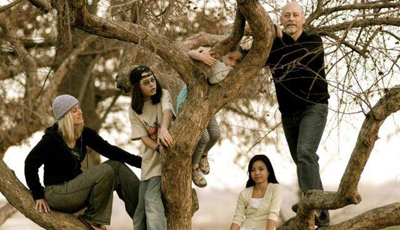
The Hauck family, from left to right: Kali’s mother – Jules, her brother – Spencer, her sister – Talulah, her father – Chris, and Kali (bottom). Photo from NBC News
“She asked, ‘Is that my food? How much do I owe you?'” recalled Rehberg.
Rehberg’s friends were more incensed than he was about his colleague’s mistaking him for a deliveryman, he said. But for the 40-year-old marketing manager at Besen & Associates who grew up in Northborough, Massachusetts, a mostly-white enclave in Worcester County, the incident was a clarion call to learn what it meant to be Asian in America, and what it means to be a Vietnamese-American adoptee.
Rehberg was one of more than 3,300 Vietnamese children who were part of 1975’s Operation Babylift, which sent orphans from war-torn Vietnam to western families in Europe, Australia and the United States. While touted as a humanitarian campaign, the operation had its critics, who alleged that the US-led effort was a public relations stunt designed to re-brand America’s sullied image after a protracted war.
Questions also emerged about whether many of the orphans were really orphans at all, or children unwillingly plucked from the homes of Vietnamese families, who felt forced to relinquish them.
Rehberg was one of 219 children placed on a US-bound flight from Saigon.
“There were no documents, no nothing,” he said. “Our names were all made up as we got on the plane to get us out of there.”
Rehberg’s adoptive parents, who were white, picked up their son in York, Pennsylvania, and moved briefly to upstate New York, before ultimately settling in Northborough in 1979. Throughout his childhood, Rehberg said he was mostly “immune to racism and bad memories,” devoting much of his time to playing music and sports and performing in school plays.
His friends accepted him, Rehberg said, and the Vietnamese adoptee who was short for his age and liked to wear a rainbow-colored jacket was all but certain he was white, just like most of Northborough.
“I liked being treated the way I was,” said Rehberg, whose younger brother is a Korean adoptee and whose older sister, adopted from Philadelphia, is half black and half white.
But New York City, where Rehberg moved as a young adult, was not Northborough. He encountered entrenched Asian stereotypes, and found it hard to make friends who were not Asian.
Rather than deny his heritage, Rehberg said he embraced it, performing at open-mic sessions in Chinatown, learning more about Asian-American history, and parlaying his love of music into teachable moments for himself and, later, for younger Vietnamese adoptees.
“After 2004, I continued my volunteer work in the adoption community, and that’s when I realized I was not really Asian American either,” said Rehberg, who writes songs that he performs at Vietnamese adoptee camps, including one held each summer in Estes Park, Colorado. “I am a Vietnamese adoptee, and that is what I carry today.”
Kali Hauck, a 16-year-old Vietnamese adoptee in Colorado, is one beneficiary of Rehberg’s experiences. Adopted in 1999, Hauck recalls a childhood not nearly as idyllic as Rehberg’s. Beginning in kindergarten, kids teased Hauck about her height — a result of her premature birth — and bullied her at the playground, she said.
Read the full story HERE.