From Dan Reimold, USA Today
Sorting hats to pick your major. Admissions decisions based solely on social media profiles. Nap pods. Cafeteria food crafted via 3D printers. And dorm-to-classroom teleportation.
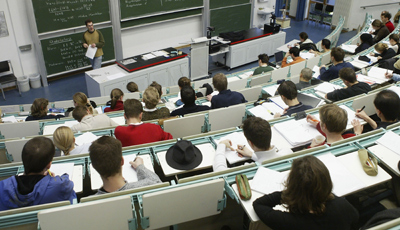
College classroom. (Photo by Sean Gallup/Getty Images)
These are a few of the many ideas my students recently brainstormed in response to a single question: What will college life be like in 100 years?
In his well-reviewed documentary “Ivory Tower,” filmmaker Andrew Rossi addressed a range of issues and innovations impacting contemporary higher education — from skyrocketing tuition and massive student debt to MOOCs (massive open online courses) and work-study hybrids.
Building off these simultaneously dispiriting and exciting present-day realities, my students were tasked with playing undergraduate prognosticator. I compelled them to predict or simply wildly imagine the inventions, routines, events, locations, individuals and traditions which may be upended or urgently utilized to run colleges and universities on a daily basis in the 22nd century. They were free to consider areas such as classes, sports, housing, partying, study abroad, the semester schedule, the cafeteria, the library, tuition costs, studying, student romance, general social interactions and campus parking.
Instead of grand-scale philosophizing, I asked them to think small, pitching a vision of how something specific might function on a college campus in or around the year 2114.
Below is a sampling of their responses. Collectively, they seem to speak to a larger student desire to engage in and benefit from a future college experience that is much more high-tech, fast-paced and sleep-friendly.
“In 100 years, higher education will be global — literally. Due to the ease and availability of traveling at the speed of light, colleges and universities will hold classes worldwide. A student can pop into their 8 a.m. Introduction to Spanish class in Madrid and then head over to Shanghai for their 10 a.m. course, Chinese History: From Mao to Now.” – Matthew Haubenstein, senior communications major at Saint Joseph’s University (SJU)
“In 100 years, students will live in the moment — and experience many past moments. Why? Two words: time travel. Students in history classes will rocket back to the periods or events they are studying. They can enjoy a front-row seat for the first staging of a Shakespeare play, check out the Civil War (from a safe distance) or relive the making of the Hoover Dam or Panama Canal. The hands-on understanding they will gain about the related individuals, events and issues will make professors’ PowerPoints or Prezis seem embarrassingly out of touch.” –Jessica Sweeney, senior English major at SJU
“In 100 years, picking a college major will no longer be on a trial-and-error basis. Instead, in the same vein as the sorting hat from “Harry Potter,” students will spend part of freshmen orientation being “sorted” into different majors. An advanced version of the Melon brainwave headband will measure students’ neuronal connections and determine which major is the best fit based on their personalities, skill-sets and personal interests. However, just like in “Harry Potter,” students will still have final say over what they end up studying.” – Leigh Anne Tiffany, senior biology major at SJU
“In 100 years, the traditional college admissions process will be dead. No more boring applications, personal essays, SAT scores or reference letters. Instead, students will be judged solely by their Facebook profiles — from the seriousness of the news they share on their feeds and the types of pages they like to the intellectual aptitude of their Facebook friends and the quality of their profile and cover photos. For graduate school, students’ Twitter and Instagram accounts will also be considered.” – Denise Sciasci, senior English major at SJU
“In 100 years, the surface of the Earth will be uninhabitable. This means prospective college students will have one of two options for continuing their schooling: traveling far, far away to one of a multitude of space station universities spread across the galaxy or heading underground to schools up and running just below the surface. For undergraduates missing the feeling of fresh air and sunshine, technology will help recreate artificial environments which look and smell exactly like a traditional college campus or a Spring Break locale.” – Tiffany
Read the full article HERE.