Hà Giang/Nguoi Viet Daily News
WESTMINSTER, Calif. (NV) – It was the afternoon before Tet (Vietnamese Lunar New Year), and the kitchen was scattered with unwrapped bánh Tét, a Vietnamese cylindrical sticky rice and mung bean cake – a must-have food for a Vietnamese Tet celebration. In the kitchen, David Brown – the veteran diplomat, expert on East Asia and famous columnist about the South China Sea — was sent to the market to buy fish sauce.
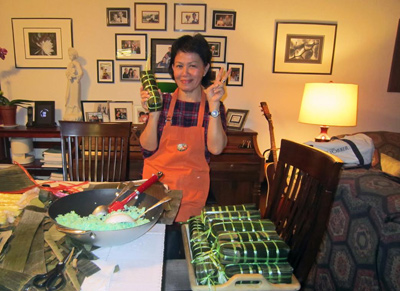
Tuyet Le-Brown making bánh Tét, preparing to celebrate Lunar New Year at their home in Fresno, California. (Photo: provided by David Brown family)
His wife, Tuyet Le-Brown (Vietnamese name: Bach Tuyet) just realized that perhaps the fish sauce bottle they had at home did not contain enough for her to make thịt kho trứng, or Braised Pork with Eggs, a traditional New Year dish of South Vietnam.
That he had to rush out to buy fish sauce at the last minute, according to Bach Tuyet, was largely his fault, because “he’s just crazy about fish sauce and tries to put it on almost every dish.”
“If I didn’t stop him, he probably would drink it!” Bach Tuyet complained in a in a happy voice, beaming with pride: “He loves Vietnam even more than I love Vietnam!”
Home in Fresno
Later, when he managed to bring home the bottle of fish sauce, columnist David Brown was deployed by his wife to perform a myriad of chores: cleaning and drying dishes, vacuuming, readying the altar, and decorating their home for Tet. Occasionally, he was asked to come into the kitchen to perform one of his favorite tasks: to taste the thịt kho trứng to make sure that the meat was sufficiently tender and the seasoning just right.
Celebrating Lunar New Year in accordance with Vietnamese traditions every year is one thing Tuyet Le-Brown always tries to do, no matter how challenging, to remind her children that Vietnamese is a big part of their heritage.
And their lives.
“I am very happy with my marriage,” Mr. Brown said during an interview with Nguoi Viet Daily News. “We are both interested in Vietnam. I find as myself as attached to Vietnam as I am to her family; we both long for what is best for this country.”

David Brown helping to make thịt kho trứng, a traditional New Year dish of South Vietnam. (Photo: provided by David Brown family)
Who said that interracial marriages are fraught with risks and instabilities?
Tuyet Le-Brown and David Brown are two familiar faces in the world of Facebook, both in America and in Vietnam. Their photos and “status” regularly appear on Facebook, portraying snapshots of two lives sharing one common goal.
But one has to come for a visit and spend a few days with them at their home to get a clear picture of the daily life of this American husband and Vietnamese wife.
The first thing you will notice about them is that Tuyet Le-Brown is very American – American in her demeanor, attire, in the perfect pronunciation of English. In contrast, David Brown is very Vietnamese – complete with almost-flawless Vietnamese, complete with a level of vocabulary and understanding about political situations in Vietnam perhaps higher than a Vietnamese mindful of these things. And most of all, Vietnamese in the way he is completely dependent on his wife, his interior minister, for all domestic arrangements, submitting himself to her directions, including the occasional grocery shopping.
The day I came to visit them in Fresno, Calif., no sooner had my car stopped in front of their house than they were both out to greet me at the door. While David quickly opened the trunk and helped me carry my luggage and camera bags, Tuyet took snapshots of her husband with their guest, then handed the camera to her husband so he could take pictures of the two of us. Warm and thoughtful they were, giving their guest the feeling they she was a distinguished guest – a gesture of skilled diplomats.
Predestined love union
That evening, after dinner, in the living room filled with objet d’art of many Asian countries where David Brown was sent to represent the United States — Vietnam, Japan, Malaysia– I had the opportunity to listen to them talk about their nearly 50-year love story. The room seemed cozier whenever one of them forgot some details and turned to ask the other. And those exchanging glances? So intimate.
It all started when David Brown, then 22 and a foreign services employee of the U.S. Department of State, was sent to serve in Vietnam in 1965, at a time when the war in Vietnam began to escalate.

Bach Tuyet and David Brown while dating. (Photo: provided by David Brown family)
Right after his plane landed at Tan Son Nhat airport, when the hot and steamy air hit his face, David Brown immediately was aware he had a lot to learn. The Vietnamese he had been taught was virtually useless. His pronunciation of the Vietnamese accents was way off. It’s only when you are in a place that you really learn how to speak that language, he thought.
To him, the ability to speak the local language was very important. The job of a foreign service officer in the U.S. State Department is to use diplomacy and charm to make friends with the natives. His job was find out who is who, who he could talk to, someone those who could help him to quickly learn all he could about this strange land. Moreover, he worked in the political division of the department.
“Then, everyone thought I was CIA. To be able to speak and write Vietnamese so well, I must surely have been a spy, ” David Brown recalled with a smile. He actually was assigned to the position of “district senior adviser” in the mobile unit. Based in the office of USAID, his areas of operation were Bien Hoa, Ho Nai, Tam Hiep, Long Binh.
And Bien Hoa was where he met a South Vietnamese girl named Bach Tuyet, who later became his wife.
Bach Tuyet was only 17 at the time, and she had to lie to be able work as a switchboard operator for USAID, which required employees to be at least 18 years old.
“I was very young then, but I noticed David for his blue eyes, his tall physique, and his ability to speak very good Vietnamese,” she recalled.
One afternoon, when both had to work a little later than usual, young David offered to give Tuyet a ride home on his motorcycle. Tuyet thought about it for a moment, then nodded with approval – a decision that tied their lives together from that moment on.
Crossing cultural barriers
Recounting the difficulties they faced in the relationship because of cultural differences, Tuyet Le-Brown talked about their “encounter” from that very first day.
“That day, on the way home, David tried to touch my thigh. I was so scared. And so, being both angry and fearful, I immediately shoved his hand away.” Tuyet said.
Tuyet stopped talking with David, and kept quiet the rest of the way, despite the American man’s profuse apologies.
The unexpected reactions from the young Vietnamese lady surprised David, causing him to ponder. And after giving the situation some thought, David suddenly realized that during the long period when he was attending training classes on Vietnamese language and culture, the State Department neglected to explain to him and his colleagues how to treat women in this country.

Bach Tuyet and David Brown leaving the church after the wedding ceremony. (Photo: provided by David Brown family)
David’s second surprise came when Tuyet’s family, especially her father, opposed his daughter’s relationship with a foreigner. David was sure that with his looks, with his prestigious job at the U.S. Department of State, with “a lot” of money, Tuyet’s parents would welcome him with open arms. He was wrong. According to Vietnamese culture at the time, even financially struggling families were not happy about the prospects of their children marrying a foreigner. As a result, it took Tuyet and David a long time to persuade her parents to accept their love for each other.
For a couple of months, every weekend David went to Tuyet’s house and visited with her father for several hours. They mostly discussed politics as it related to Vietnam. During his visits, David could only occasionally steal a glance at Tuyet, who appeared once or twice to serve beverages.
Finally, David felt he had a “glorious victory” when Tuyet’s father allowed them to go on a date. Even so, Tuyet’s younger brother always accompanied them as a chaperone until they bribed him to let them have some private moments.
When Tuyet’s father knew he could not stop the love his daughter and David had for each other, he told David he would only agree to bless their marriage if David met three conditions: First, David had to ask his family to come to Vietnam to ask for her hand in marriage in accordance with Vietnamese tradition; second, David had to become a Catholic; and finally, all of their children would have to be brought up as Catholics.
The two married in June 1969, shortly before David Brown returned to the United States.
During their marriage, Tuyet and David have had to deal with many other cultural differences, such as helping family.
“We often had to send money to Vietnam. We argued constantly about it,” David said. “I found it unreasonable that we had to continue to help her family while we are also trying to build our own lives together. However I understood Tuyet much much later, when I realized that like many others, Tuyet felt guilty because she had better luck in life and felt a responsibility to care for loved ones who were left behind.”

David Brown (left) with two daughters and wife Tuyet Le-Brown (right). (Photo: provided by David Brown family)
How did Tuyet manage to persuade him?
“Oh, by going out to find a part-time job while our daughter was still very young. Tuyet first worked as a salesperson in a men’s clothing store, and then later worked in a fabric shop. Only after a short time, she received a recognition ‘pin’ from the store for being the best at serving the customers.
“Perhaps she shamed me into it; her actions made me willing to help her family,” he remembered.
Then, to his wife’s surprise, he revealed what he thought of her, perhaps for the first time:
“Tuyet is probably the most wonderful Vietnamese woman that I met. Intelligent, energetic, stubborn and will not let life defeat her. To me, Tuyet is not just attractive physically. She has very strong will power. After our marriage, she took care of the children, carried out the responsibilities of a diplomat’s wife, and still managed to complete her master’s degree in mental health.”
“And now, looking at her, I sometimes say to myself I am such a lucky man, because Tuyet really did pick me,” he conceded.
Tuyet Le-Brown and David Brown have two daughters, one a graduate of Harvard University, the other a graduate of Brown University. They also have a 3-year-old grandson. In Fresno, Tuyet Le-Brown is board-licensed clinical psychotherapist.
When not reading, giving interviews or writing essays for the Asia Times, Sentinel Asia or East Asia Forum, David helps Tuyet with cooking, gardening and especially grocery shopping, buying those ingredients for traditional Vietnamese food.
As for Lunar New Year’s Day food, he likes thit kho trung (Braised Pork with Eggs) and pickled mustard greens, and he prefers banh Tet to banh Chung.
“Of course, because his wife is from the South,” Tuyet commented wittily.
How well she knows him.
—-
Contact the writer: [email protected]
Read this story in Vietnamese