By Yuan-Kwan Chan, Meniscus
In a mockumentary capturing the Bruce Lee post-death frenzy of cashing in on the suddenly popular martial arts genre – the 2007 Justin Lin film “Finishing the Game” – the actor Dustin Nguyen plays the actor Troy Poon, who just wants a role that requires more work than pointing a gun or a single line such as, “That will be $14.39.”
Dustin Nguyen took on the lead role of Dao in his directorial debut, “Once Upon a Time in Vietnam.” (photo courtesy of the Busan International Film Festival)
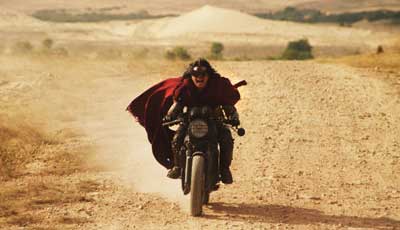
While Troy may have floundered in his quest, in real life Nguyen did find the type of role that first put him on the map – his turn alongside Johnny Depp in the original 21 Jump Street television series – and much more. An opportunity to act in his first Vietnamese film, “The Rebel” co-starring Johnny Tri Nguyen and Veronica Ngo, eventually opened the door to Best Actor awards (including the Vietnamese Golden Lotus Award, the country’s equivalent of the Oscars) and newfound roots in his birthplace of Ho Chi Minh City. Nguyen’s directorial debut, “Once Upon a Time in Vietnam,” also checked off many domestic milestones, becoming the first fantasy genre film ever made in the country, the first with substantial use of special effects and its seven-digit budget resulting in the most expensive film produced in Vietnamese history. In addition, Nguyen stars as Dao, a caped warrior monk anti-hero, armed and staggering into a small town where he finds refuge in the home of a humble baker (played by Thái Hòa), his mysterious wife Anh (Ngo) and their troubled young son. Soon, Dao’s link to the family is revealed, along with the real reason that he has searched for Anh in particular.
Meniscus Magazine talked to Nguyen at the 2013 Busan International Film Festival, where “Once Upon a Time in Vietnam” made its international premiere. He talked about what it was like to direct and act at the same time, the reality of filming in Vietnam versus Hollywood, and how he convinced his parents to become involved in his career.
Yuan-Kwan Chan: Thank you for taking the time to chat with me.
Dustin Nguyen: Thank you for giving me the time.
So, I watched the film yesterday. Very entertaining.
Oh, you did? You were at the screening?
Well, I couldn’t see it at the screening. I had to watch it on a choppy computer on a video.
Aw, I wish you could see it on the big screen, you know.
Yes, I don’t think I got the full visual, so I’ll have to see if I can catch it again. I wanted to ask: I’m sure the decision to direct your first feature-length film, particularly in Vietnam, must have required a lot of thought, a lot of time. Why did you choose Vietnam for your debut?
Well, it took about four years, almost five, since I wrote the screenplay and just sort of nursed it along, trying to find a home to make it, and trying to find someone who would actually give you your first shot at directing a film – especially a film of this scope.
I started going back to Vietnam about five years ago. Sort of fate, really. I never thought I’d be in Vietnam. I started to go there to make movies. The first one was called “The Rebel,” it was quite a nice film. But I didn’t think…you know, you would make a movie and you would go home. [Then] every year I would go back to make another Vietnamese-language film. I just really enjoyed it because they were roles with great depth and roles that you wouldn’t see in Hollywood for Asian Americans.
So I started meeting people there in the industry, which is very small, and started a production company there around two years ago. This project, of course, went through a couple potential [companies] in L.A. FOX International, at one point, was very interested in it. But I realized that in order to find someone that can trust me, or give me a shot anyway, and I can still have creative control – I have to make it for the least amount of money. Having produced a couple of films in Vietnam, it was very obvious to me that economically, that was the place that I would attempt this. And the budget on it for Vietnam, it’s on the high side. This is the first fantasy genre [film] for Vietnam. It’s nothing new for international cinema. It is just a pathetically small budget compared to, let’s say, a Korean film. It’s still very, very small.
But I made a decision because I wanted it to have a Vietnamese soul, even though I wanted it to not be a Vietnamese film that people are used to expect to come out of Vietnam. At the same time, I wanted the characters to speak Vietnamese, and I wanted it to be made by Vietnamese. And that’s sort of the genesis of it. As you can tell, I have a great adoration for Sergio Leone, so I thought this is how I would do it.
It was extremely difficult to make because the infrastructure there is not quite set up yet for a film of this scope. But considering that, I am very proud of a lot of the technical stuff that we pulled off. I had a terrific costume designer from Los Angeles that I begged to come and work on this for nothing. My DP was from Thailand and one of my good friends who played the villain, Roger Yuan, I begged him to come over – he had never been to Vietnam. So I had a lot of great people supporting me because they know that it was a real passion project of mine.
Read the full article by Yuan-Kwan Chan, Meniscus.