By Carl Robinson, Metropolis
The recent downturn in Sai Gon may—in the long run—be good for its architectural heritage.
The Thu Thiem Ferry Crossing on Sai Gon’s meandering Saigon River. The towers of downtown, most of them constructed in the past 15 years, loom in the distance. Courtesy Derek Hoeferlin
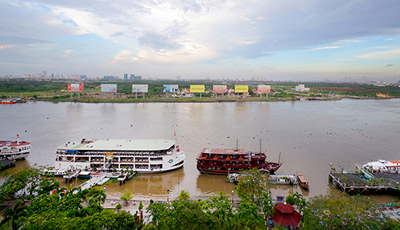
Over the past 15 years, as Vietnam finally left its long years of war behind, the former capital of South Vietnam—Saigon—became the country’s economic powerhouse. Until fairly recently, Sai Gon was a boomtown. Even before touching down at its busy international airport, I see new buildings rising up through the sprawling and tightly packed suburbs, splayed across the city’s surrounding delta landscape and muddy meandering rivers.
Off in the distance along the wide Saigon River, where the spires of the city’s French Colonial Roman Catholic cathedral once dominated downtown, an impressive silhouette of high-rises reach to the tropical sky. The city’s twenty-first-century feel continues through its sweeping new terminal (designed by GWA) and then down a wide boulevard past contemporary office buildings and shops. Eventually I reach the intimate tree-lined streets of old Saigon, the residential quarter created by the French more than 150 years ago.
In the city I first knew in 1964—before large numbers of U.S. troops arrived and the war intensified—Saigon’s French Colonial buildings endured with a seedy and languid charm. Monsoon mildew crept up plastered walls no longer whitewashed every dry season. Huge fans whopped away overhead, stirring up a breeze and keeping the mos-quitoes away. At day’s end, nothing beat sitting in rattan chairs for drinks on the vast open-air terrace of the Continental Hotel, nicknamed the Continental Shelf, or on the rooftop of the Majestic Hotel along the Saigon River, with the incongruous sounds of war booming in the distance.
Read the full experience by Carl Robinson from Metropolis.