By Peggy Lowe, NPR
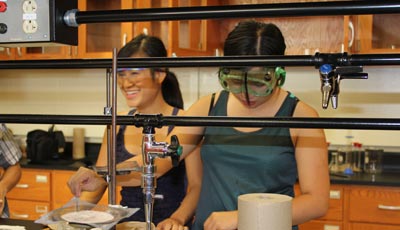
Binh Hua (left) and My Nguyen, both 18, work in the Garden City Community College chemistry lab. Both of their parents are employed by the Tyson Foods plant in Garden City, Kan. // Harvest Public Media, Peggy Lowe
Starting in the 1980s, leaders in Garden City, Kan., decided that they were going to treat the immigrant influx as a blessing, not a curse. Working conditions are tough, but the jobs offer decent wages, and a good support system provides a brighter future.
Meatpacking plants used to be located in urban centers like Kansas City and Chicago. Over the past few decades, many plants have moved to rural Midwestern towns, which have seen a huge influx of immigrants as a result. Yesterday, we reported on tiny Noel, Mo. , which has struggled to help assimilate the newcomers who work at a large poultry plant. Today, we have this report from Garden City, Kan., a meatpacking town that embraces its new cultures.
The chemistry lab at Garden City Community College is buzzing, and Binh Hua and My Nguyen are at the front of the class. The two young women wear protective goggles, their long black hair pulled into ponytails, as they wait for the professor to bring the class to order.
Both of these Vietnamese 18-year-olds have benefited from the beef industry since their parents moved here to work in the huge Tyson Foods plant. Now they dream of computer and medical degrees as their parents do the hard work of turning animals into beef at a slaughterhouse on the outskirts of town. Both students graduated from high school in just three years, and they’re trying to earn associate degrees by next year.
“We really like to graduate early because we think high school wasn’t challenging enough and we were looking for challenging courses and stuff,” Hua says.
“And we get a head start in college,” Nguyen adds.
Hua and Nguyen represent the newest chapter in an age-old American story: Immigrants have always worked in the meatpacking plants, lured by steady — if hard — work. Since 1980, when the first slaughterhouse was built in Garden City, Kan., the newcomers have doubled the population to roughly 30,000 and turned a white cow town into a cultural crossroads where minorities are now the majority. But Garden City’s response differed from many in the rural Midwestern towns: City leaders decided early on that they would embrace these newcomers.
Read the full story by Peggy Lowe from NPR.