By Hope Gillette, VOXXI
Dr. Kent Brantly, an Ebola virus survivor, generously donated his blood to be used in the treatment of Texas nurse Nina Pham who contracted the disease working with a Liberian patient.
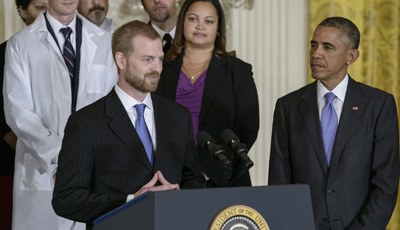
US President Barack Obama (R) listens as Ebola survivor Dr. Kent Brantly introduces him during an event in the east room of the White House October 29, 2014 in Washington, DC. Obama spoke about the administrations efforts to combat Ebola in the US and abroad. (BRENDAN SMIALOWSKI/AFP/Getty Images)
Though the practice of using blood transfusions for treatment of Ebola is has no long-term proven track record, experts felt scientific evidence supported the therapy enough to warrant its implementation.
They may have been right, as Nina Pham was released from the hospital on October 24th, free from Ebola. Did the blood transfusions play a role?
According to medical officials keeping track of the Ebola outbreak, there is a good chance the antibodies from Brantly helped Pham’s immune system combat the virus.
“Convalescent serum is high on our list of potential therapies and has been used in other outbreaks,” a World Health Organization spokesman told Science magazine in August. “There is a long history of its use (for other diseases), so lots of experience of what needs to be done, what norms and standards need to be met.”
The theory behind using serum from an Ebola survivor has to do with passing along antibodies against the virus.
In order for someone to survive Ebola–or any virus–their body must produce antibodies in an immune response to combat the invading pathogen.
According to material from the University of California, San Fransisco, antibodies bind with invading pathogens to neutralize them and then recruit other cells to come break down the pathogen and expel it from they system.
The down side is it can take time to build up enough antibodies to fight off a virus like Ebola, and during that time the virus is wreaking havoc on internal organs.
By taking survivor’s blood, which is already filled with antibodies, and giving it to a new Ebola patient, that patient doesn’t have to go through the process of amassing their own immune response; therefore, decreasing the amount of time Ebola has to cause harm within the body.
The less harm Ebola is able to do, the more likely the individual is to make a full recovery.
Read the full article HERE.